Gold and silver have reached unprecedented price levels, setting new all-time highs amid ongoing economic uncertainties. Factors such as geopolitical tensions, expectations of interest rate cuts, and a weakening U.S. dollar have driven investors to seek refuge in these precious metals. Silver recently surpassed $53 per ounce, while gold climbed beyond $4,100 per ounce, marking historic milestones for both metals.

This surge reflects a broader trend where precious metals serve as safe-haven assets during times of market volatility. The rally follows years of consolidation, with silver gaining significant momentum alongside gold’s performance. Strong demand, combined with global economic shifts, continues to fuel the upward price movement.
Investors face a complex environment where potential risks coexist with opportunities for gains. Understanding the factors behind these record prices is essential for assessing whether gold and silver can maintain their rally or face corrections ahead.
Understanding All-Time Highs in Precious Metals

Gold and silver reaching all-time highs reflect important market dynamics and historical trends. These highs are driven by a mix of macroeconomic factors, investor behavior, and supply-demand imbalances that directly influence pricing and market confidence.
Definition of All-Time Highs
An all-time high refers to the highest price level that gold or silver has ever reached in recorded market history. This price is typically measured in U.S. dollars per troy ounce for gold and per ounce for silver.
All-time highs signify a peak in market value, influenced by real-time trades and futures contracts. They serve as crucial benchmarks for investors and analysts, showing maximum market optimism or concern about future economic conditions.
The achievement of an all-time high indicates strong buying interest, often fueled by external events. Previous price records provide historical context, helping market participants gauge risk and opportunity.
Historical Significance of Gold and Silver Highs
Gold and silver all-time highs often correspond to periods of economic uncertainty or geopolitical tension. For example, spikes in the late 1970s and during the 2008 financial crisis reflected investor demand for stable assets amid volatility.
Historically, metals prices have tracked inflation expectations and currency fluctuations. Gold’s role as a monetary metal gives it long-term importance during periods of weakened fiat currencies.
The recurrence of record highs reflects changing market fundamentals and investor perceptions. Each new high sets a new reference point for future price movements and portfolio strategies centered on precious metals.
Factors Leading to Record Prices
Several key factors drive gold and silver to record levels. These include geopolitical instability, inflation pressures, and central bank policies that favor precious metals as a hedge.
Supply constraints, such as mining disruptions and limited availability of physical metal, also contribute. Increased industrial demand, particularly for silver, impacts prices along with investment demand.
Global currency diversification away from the U.S. dollar and rising interest in physical assets fuel demand. Additionally, technical market conditions like overbought indicators can extend price rallies during these all-time highs.
| Main Factors | Impact on Prices |
|---|---|
| Geopolitical Risks | Increase safe-haven buying, pushing prices higher |
| Inflation | Raises demand to preserve purchasing power |
| Supply Constraints | Reduce availability, tightening market supply |
| Central Bank Policies | Increase accumulation and market confidence |
Current Market Drivers for Gold and Silver
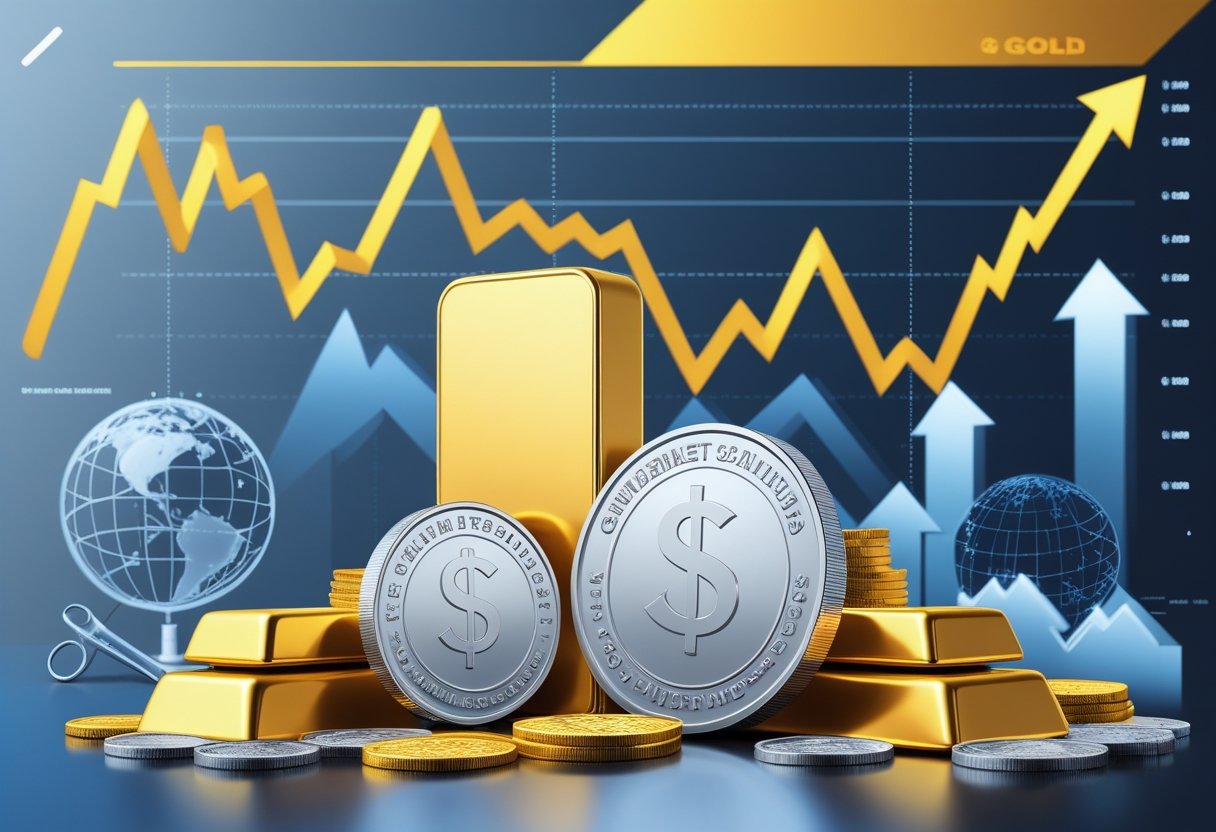
Gold and silver have reached all-time highs due to several interrelated factors affecting the global financial landscape. Key influences include ongoing geopolitical tensions, inflation pressures, currency shifts, and active central bank interventions. These forces create a complex environment that supports elevated precious metal prices.
Global Economic Uncertainty
Rising geopolitical tensions and unpredictable trade relations have increased demand for safe-haven assets. Conflict escalation concerns and instability in major regions prompt investors to allocate more funds to gold and silver as protection against risk.
Economic slowdowns in key markets also contribute to uncertainty. Weak industrial activity limits silver’s industrial demand but enhances its appeal as an investment alongside gold. The combination of these factors keeps both metals attractive in volatile times.
Inflation and Currency Fluctuations
Persistent inflationary pressures worldwide have eroded purchasing power, increasing interest in gold and silver as hedges against rising prices. Gold’s ability to preserve value during inflation makes it a preferred store of wealth, particularly as consumer prices remain elevated.
Simultaneously, fluctuations in major currencies, especially the U.S. dollar, affect precious metal prices. A weakening dollar lowers the cost of gold and silver for holders of other currencies, boosting global demand and pushing prices higher.
Central Bank Policies
Central banks, particularly in major economies, have played a crucial role by increasing gold reserves in 2025. This record level of central bank buying supports prices by tightening supply and signaling confidence in gold as a strategic asset.
In addition, accommodative monetary policies—such as maintaining low interest rates—reduce opportunity costs for holding non-yielding assets like gold and silver. This environment encourages investment in precious metals as part of diversified portfolios.
Comparing Gold and Silver’s Performance
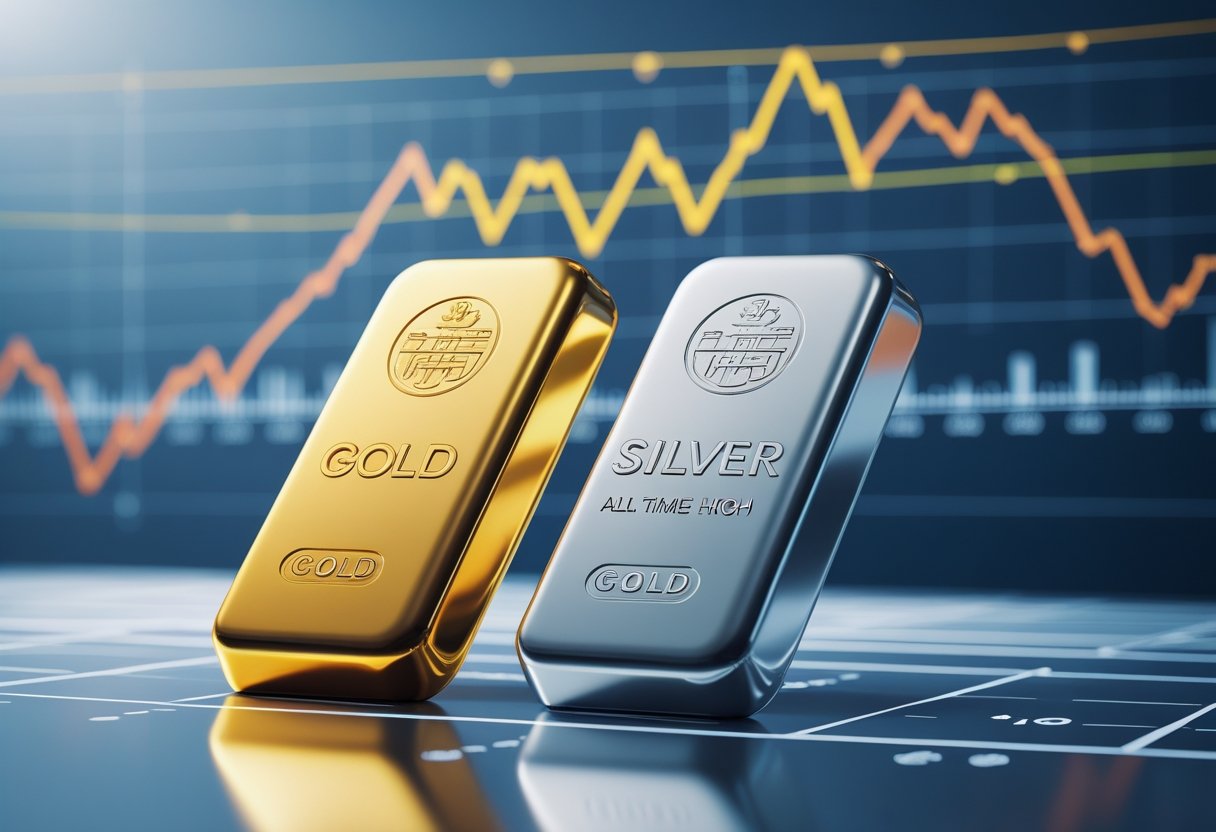
Gold and silver have both reached all-time highs, but their price movements and relationships with other asset classes differ. These distinctions influence how investors evaluate their roles in portfolios.
Gold Versus Silver Price Movements
Gold has historically shown steadier and stronger growth compared to silver. From 1999 to 2025, gold’s price has increased significantly more in percentage terms, reflecting its status as a safe-haven asset with limited supply. Silver, in contrast, is more volatile due to its dual role as a precious metal and an industrial commodity.
Recent trading saw gold hit $4,186 per troy ounce, while silver reached $53.59 per ounce. Silver’s increased volatility often results in sharper price rallies and corrections. The gold-to-silver price ratio remains elevated, indicating gold’s superior price appreciation over past decades.
| Metal | All-Time High (2025) | Key Price Driver | Volatility |
|---|---|---|---|
| Gold | $4,186 / troy ounce | Limited supply, safe haven | Lower |
| Silver | $53.59 / ounce | Industrial demand | Higher |
Correlation with Other Asset Classes
Gold maintains a strong negative or low correlation with equities and bonds, which makes it an effective portfolio diversifier during market stress. Its demand increases in economic uncertainty and inflationary periods.
Silver shows a mixed correlation profile. While it reacts to economic conditions like gold, its industrial use links its price more closely to broader economic trends and commodity markets. This connection can cause silver prices to move with industrial demand and economic growth, resulting in more pronounced sensitivity to cyclical factors.
Investors often view gold as a more reliable store of value and inflation hedge. Silver’s correlation with both precious metals and industrial demand creates a layered risk and return profile that suits different investment strategies.
Implications for Investors

Investors are facing a market where gold and silver prices are at unprecedented levels. This scenario calls for specific approaches toward portfolio adjustments and risk assessments to navigate potential volatility and capitalize on new opportunities.
Portfolio Diversification Strategies
With gold surpassing $4,000 per ounce and silver exceeding $54, investors are prompted to reassess asset allocations. Incorporating precious metals can provide a buffer against inflation and currency depreciation, especially amid geopolitical uncertainties and rising U.S. debt concerns.
Investors might consider diversifying through physical bullion, ETFs, or mining stocks, each offering different liquidity and risk profiles. Metals often move inversely to equities, enhancing overall portfolio stability.
A balanced approach is key. Overexposure could lead to vulnerability if prices correct. Monitoring correlation trends between metals and other asset classes helps maintain effective diversification. Regular portfolio reviews and adjusting metal holdings based on economic indicators support this strategy.
Risk Management Considerations
The rapid price increases bring heightened volatility and speculative risks. Investors should be aware that while precious metals serve as a safe haven, price swings can be sharp due to market sentiment and external shocks like changing trade relations or monetary policy shifts.
Risk management includes setting clear entry and exit points and using stop-loss orders to protect gains. Understanding the liquidity and cost structure of chosen investment vehicles is crucial; for instance, physical gold entails storage costs, while ETFs can be traded easily but might not track prices perfectly.
Additionally, hidden risks such as regulatory changes and fluctuating demand in mining sectors must be accounted for. Maintaining a well-defined risk profile and avoiding excessive leverage will help mitigate downside exposure amid uncertain market conditions.
Historical Context of Precious Metals Bull Markets
Gold and silver have experienced significant price surges during distinct periods, often linked with economic or geopolitical shifts. These bull markets have produced substantial gains, but notable downturns have also followed. Understanding past peak prices and market cycles offers insight into current trends and potential future movements.
Notable Previous Highs
Gold and silver have set remarkable price records during previous bull markets. For example, gold reached new peaks in 1972, 2009, and more recently, each followed by multi-year gains of 300-500%. Silver’s 1973 surge of 125% marked the first major leg of the 1970s bull run.
Prices often hit all-time highs during economic stress or inflationary periods. For instance, gold’s all-time spot price reached $4,186 per ounce and silver hit $53.59 per ounce before retreating slightly. These spikes tie closely to monetary expansion, currency debasement, and geopolitical uncertainty.
Lessons from Past Market Cycles
Historical cycles show bull markets generally last for several years but include periods of volatility. After the initial surge in the early 1970s, both metals fell significantly—gold and silver declined about 45%, while gold stocks dropped 70%. This illustrates the risk of sharp corrections even within a longer bull phase.
Gold has consistently served as a safe haven during downturns, offering steadier protection, while silver tends to outperform gold percentage-wise in bull markets. Breakouts from long-term consolidation periods typically signal the start of strong upward trends, as witnessed in the 1970s and more recent decades.
| Key Takeaways | Description |
|---|---|
| Duration | Bull markets often last 3-9 years |
| Price Gains | 300-500% gains typical after breakout highs |
| Risk | Significant corrections can occur mid-cycle |
| Asset Roles | Gold: steady safe haven; Silver: higher percentage gains |
Market Outlook and Future Predictions
Gold and silver have reached unprecedented price levels due to various economic and geopolitical factors. Their future trajectories will largely depend on market dynamics, investor behavior, and external influences such as policy changes and global events.
Analyst Forecasts
Analysts project that gold will continue to experience a moderate rise, with estimates suggesting a 6% increase by mid-2026. This is driven by sustained demand from central banks and investors seeking hedges against inflation and currency fluctuations. Silver prices also remain strong, though more volatile, as industrial demand linked to green energy transitions supports its value.
Investment firms recommend a “buy on dips” approach, expecting periodic price oscillations. However, the general consensus is a favorable outlook for the next 5-6 months. Gold’s 40% increase in 2025 positions it for continued gains, potentially surpassing previous records as geopolitical tensions persist.
Potential Risks and Opportunities
Key risks include interest rate changes, which can reduce the appeal of non-yielding precious metals. Trade tensions and inflation uncertainty may trigger price swings or temporary corrections. Additionally, shifts in Federal Reserve policy could impact market sentiment sharply.
Opportunities arise from geopolitical instability, central bank purchases, and the accelerating demand for silver in renewable energy technologies. Investors might benefit from diversifying into both metals, capitalizing on their distinct roles as safe havens and industrial resources. Monitoring policy updates and global events remains crucial for risk management.