Silver is gaining attention as a potentially stronger performer than Bitcoin in the upcoming bull run. This shift is driven by factors like rising industrial demand, loose monetary policy, and its undervalued status compared to gold. Silver’s combination of tangible industrial use and monetary appeal positions it to outperform Bitcoin during periods of economic uncertainty and market volatility.
While Bitcoin remains popular among digital asset investors, silver offers a unique blend of physical asset security and growth potential. Experts note that silver’s price movements tend to be less speculative and more influenced by real-world demand, making it a safer choice for some investors in the current economic climate.
Institutional interest and regulatory clarity benefiting cryptocurrencies may also boost silver, but its fundamental strengths make it a compelling alternative. The ongoing revaluation of precious metals highlights why silver could outpace Bitcoin in returns throughout the next market cycle.
Historical Performance of Silver vs. Bitcoin
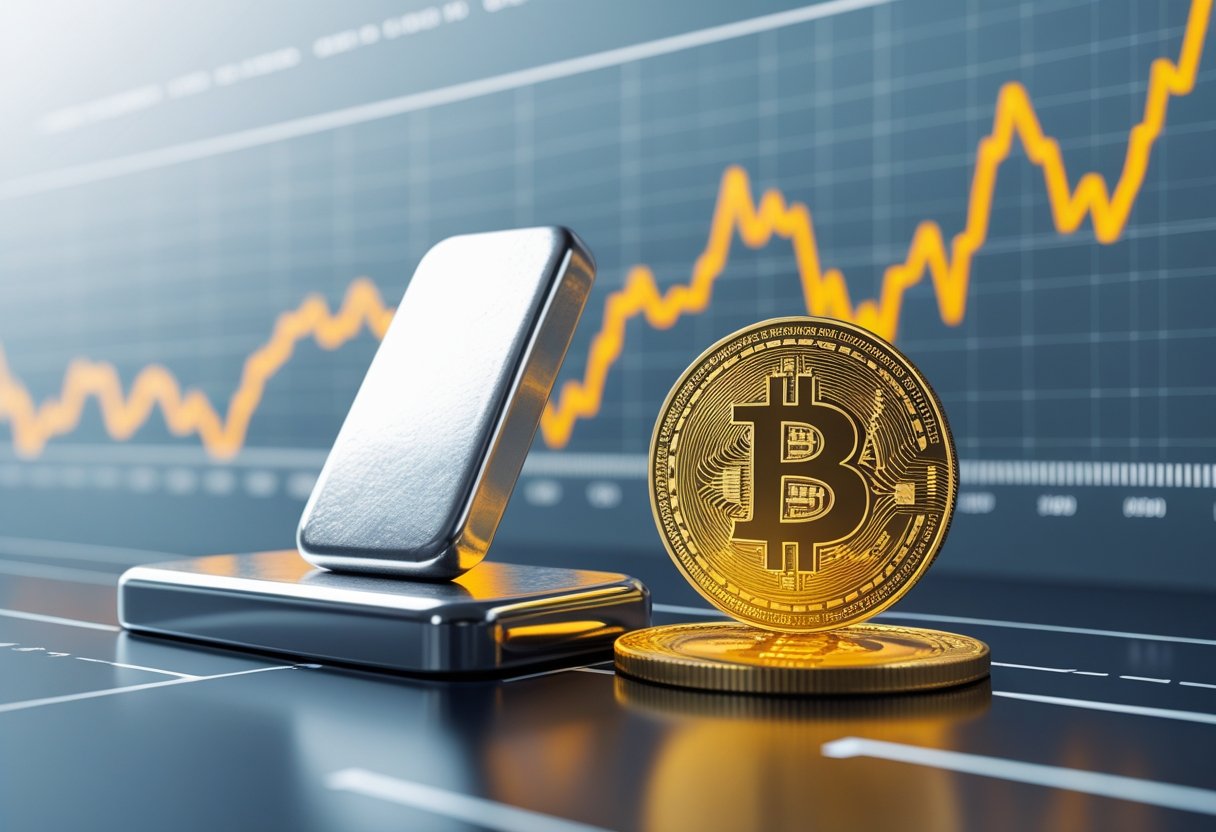
Silver has a long-established history as a store of value, while Bitcoin is a relatively new digital asset. Their price behaviors during bull runs, volatility levels, and market cycle responsiveness reveal important distinctions for investors considering their next moves.
Comparative Analysis of Past Bull Runs
Silver has experienced multiple bull runs over decades, notably peaking around 1980 and more recently in 2011 and 2020. These rallies were often tied to macroeconomic factors like inflation fears and industrial demand. Silver’s price increases tend to be steady but less explosive than Bitcoin.
Bitcoin’s bull runs, beginning with its first major surge in 2013, have been marked by rapid and dramatic price spikes. For example, Bitcoin surged from a few hundred dollars to nearly $69,000 in late 2021. This rapid growth reflects its novelty and high demand driven by speculative interest.
Price Volatility and Growth Patterns
Bitcoin exhibits significantly higher volatility compared to silver. Its price can swing more than 10% in a single day, often driven by regulatory news, institutional adoption, or market sentiment shifts.
Silver’s price movements are smoother with less extreme daily swings. Its growth is more incremental due to its industrial uses and long-established market. Investors see silver as a safer hedge against inflation and currency devaluation, unlike Bitcoin’s sometimes unpredictable spikes.
Market Cycles and Asset Correlations
Silver’s price generally correlates with traditional market trends and commodity cycles, influenced by economic growth, inflation rates, and industrial demand. It can act as a hedge during stock market downturns or currency instability.
Bitcoin shows mixed correlations, sometimes moving independently of traditional assets. During some market sell-offs, it has behaved like a risk asset, losing value alongside stocks. At other times, it has acted as a digital gold-like store of value, attracting investors seeking alternatives.
| Aspect | Silver | Bitcoin |
|---|---|---|
| Market History | Several centuries | About 15 years |
| Volatility | Moderate | Very high |
| Industrial Demand | Significant | None |
| Correlation with Stocks | Moderate to inverse | Variable |
| Bull Run Price Growth | Steady and incremental | Rapid, explosive |
Fundamental Drivers of Silver’s Outperformance
Silver’s potential to outperform comes from a unique combination of rising industrial demand, shifting monetary policies, and persistent supply limitations. These factors create a strong foundation that could drive silver’s value higher compared to other assets.
Industrial Demand and Technological Applications
Silver has crucial industrial uses, especially in electronics, solar panels, and medical technology. Its superior conductivity and antimicrobial properties make it indispensable in sectors like renewable energy and healthcare.
Growing adoption of green technologies, such as photovoltaic cells, sharply increases silver consumption. This trend is expected to continue as countries push for cleaner energy and electrification.
Industrial demand often outweighs investment demand in silver’s price formation. The physical metal’s necessity in advancing technology provides a steady, expanding baseline for silver’s price support during market shifts.
Monetary Policy and Safe-Haven Appeal
Inflationary pressures and expansive monetary policies have renewed interest in precious metals as stores of value. Silver offers both a hedge against currency debasement and a lower-priced alternative to gold for investors seeking safety.
Unlike Bitcoin, silver combines monetary appeal with practical industrial use. This dual role helps shield silver’s value during geopolitical tensions and economic uncertainty.
Central banks and institutional investors monitoring inflation trends may increase silver holdings, reinforcing its safe-haven status without the volatility often seen in cryptocurrencies.
Physical Supply Constraints
Silver’s supply is limited by declining mining output and few new projects coming online. This restricted physical availability creates a structural deficit, supporting upward price momentum.
Unlike Bitcoin, which can be mined digitally at a predictable rate, silver’s supply depends on extraction challenges and regulatory approvals. These factors cap supply growth.
The persistent supply-demand imbalance, paired with rising industrial uses, suggests silver could experience sustained price pressure, making it attractive for investors focusing on tangible assets.
Risks and Limitations Facing Bitcoin
Bitcoin faces several challenges that could impact its performance in future market cycles. Regulatory pressures, adoption hurdles, and increasing competition all create uncertainty around its growth and stability.
Regulatory Uncertainty
Bitcoin’s regulatory environment remains complex and inconsistent worldwide. Governments vary widely in their approach, with some imposing strict measures and others adopting a more permissive stance.
This unpredictability affects investor confidence and market behavior. Regulatory crackdowns or unfavorable legislation could trigger significant price volatility or restrict usage.
Additionally, evolving policies concerning anti-money laundering (AML) and know-your-customer (KYC) regulations increase compliance costs. These regulations can deter institutional adoption and complicate Bitcoin’s integration into traditional financial systems.
Market Saturation and Adoption Challenges
Although Bitcoin has gained broad recognition, it faces challenges in expanding its user base further. Mass adoption depends on overcoming technical barriers like scalability and transaction speed.
High fees and slow processing times during peak demand periods limit Bitcoin’s practicality for everyday transactions. Moreover, digital literacy and access to secure wallets can exclude potential users.
Institutional adoption remains uneven. While some companies and funds invest heavily, others remain cautious due to regulatory and volatility concerns. This uneven adoption could slow Bitcoin’s growth compared to assets with more established use cases.
Competitive Landscape Among Cryptocurrencies
Bitcoin is no longer the sole focus within the crypto space. Thousands of alternative cryptocurrencies (altcoins) compete for investment and real-world applications.
Some altcoins offer technical advantages, such as faster transactions or smart contract functionality, reducing Bitcoin’s dominance in certain segments.
This growing competition fragments market interest and capital. Investors may diversify into assets perceived as having stronger technology or niche use cases, potentially limiting Bitcoin’s future upside.
Bitcoin’s position as “digital gold” depends on continued investor trust despite these pressures, but alternatives challenge that narrative by addressing some of Bitcoin’s limitations.
Investment Strategies for the Next Bull Run
Investors should focus on balancing exposure between silver and cryptocurrencies, choosing precise moments to enter or exit positions, and applying strict risk controls to protect capital. These approaches help capitalize on market movements without excessive vulnerability.
Portfolio Diversification Using Silver
Silver offers a distinct advantage as a diversification tool due to its role as both a precious metal and an industrial commodity. Its price often moves independently of cryptocurrencies and traditional equities, providing a hedge during market turbulence.
Including silver in a portfolio reduces reliance on Bitcoin or altcoins alone. A recommended allocation might range from 10% to 25% of the investment portfolio, depending on risk appetite. Physical silver, silver ETFs, and mining stocks are common vehicles.
Diversification helps in capturing gains when silver outperforms. Its demand is influenced by factors like industrial use and inflation, which may not directly affect crypto prices. This creates an opportunity to balance high volatility in digital assets with silver’s comparatively stable profile.
Timing Entries and Exits
Timing is critical when investing in silver and cryptocurrencies during a bull run. Investors should monitor key indicators like industrial demand trends, inflation rates, and ETF approval news for silver.
Entry into silver positions may be best timed ahead of expected industrial demand increases or growing macroeconomic uncertainty. Conversely, investors should consider exiting or reducing holdings if silver shows signs of overheating or if crypto momentum reaches an extreme phase.
Using technical analysis alongside fundamental data, such as inflation forecasts and regulatory developments, can aid in making informed timing decisions. Regularly reviewing the market environment helps avoid getting caught in late-stage rallies or early declines.
Risk Management Considerations
Risk control is essential given the price swings common to both silver and cryptocurrencies. Setting stop-loss orders protects capital if prices fall sharply. Position sizing should reflect investor tolerance for volatility, often smaller for silver mining stocks than physical silver or ETFs.
Investors must be aware of the liquidation risks in crypto markets and the potential for sudden industrial demand changes impacting silver prices. Maintaining liquidity to act quickly when market conditions shift is important.
Allocating investments across different asset types within silver and crypto sectors helps mitigate concentrated risks. Ongoing evaluation of portfolio performance against benchmarks ensures adjustments can be made promptly if the market environment changes.
Macroeconomic Factors Impacting Silver and Bitcoin
Silver and Bitcoin react differently to global economic forces, making their performance sensitive to various macroeconomic factors. Inflation trends, central bank actions, and geopolitical tensions all create distinct investment dynamics for these assets.
Global Inflation Trends
Rising inflation typically drives demand for silver as a traditional hedge. Silver’s long history as a store of value and its industrial uses give it a dual role, helping preserve purchasing power while benefiting from industrial growth.
Bitcoin, as a relatively new asset, also gains appeal during inflationary periods but shows higher price volatility. Investors may turn to Bitcoin to protect against currency debasement, yet its limited historical data leaves uncertainty about its sustained inflation hedge capacity.
Inflation impacts silver more predictably due to its tangible nature, while Bitcoin’s reaction depends heavily on market sentiment and broader adoption trends.
Central Bank Policies
Central bank decisions on interest rates and monetary policy influence both silver and Bitcoin, but through different mechanisms. Lower interest rates and potential rate cuts tend to benefit silver by reducing the opportunity cost of holding non-yielding assets and weakening the US dollar.
Bitcoin benefits from looser monetary policy as it increases liquidity and can drive risk appetite. However, interest rate hikes can lead to crypto market pullbacks as borrowing costs rise and investors shift to safer options.
Federal Reserve actions targeting inflation or economic growth create volatility but also shape buyer behavior in precious metals and cryptocurrencies differently.
Geopolitical Instability
Geopolitical tensions often increase demand for safe-haven assets, supporting silver due to its long-standing role in wealth preservation during crises. Heightened uncertainty can also disrupt supply chains, particularly for silver’s industrial applications, tightening supply and pushing prices higher.
Bitcoin’s decentralized nature can attract investors seeking alternatives to traditional financial systems during geopolitical unrest. However, regulatory crackdowns and market disruptions can increase Bitcoin’s short-term volatility.
While both assets provide relative safety, silver benefits from its physical presence and broad industrial demand, whereas Bitcoin’s response depends largely on market perception and regulatory environments.
Sentiment and Public Perception Shifts
Investor attitudes toward silver and Bitcoin are evolving based on risk tolerance and market developments. Public sentiment in financial markets often follows identifiable patterns influenced by broader psychological and economic factors.
Shifts in Investor Preferences
Investors are increasingly leaning toward silver due to its tangible industrial uses and limited downside risk compared to Bitcoin’s high volatility. Silver offers practical value in sectors like electronics and solar energy, supporting demand beyond speculative interest.
Mass psychology suggests that after extended bullish cycles, sentiment shifts as investors seek safer assets. This behavior aligns with Elliott Wave theory, which predicts cyclical patterns in public sentiment—often prompting moves toward metals like silver as counter-trend assets.
Silver’s appeal grows as some market participants rotate out of crypto assets amid fears of sharp reversals in Bitcoin prices. This rotation reflects a preference for assets perceived as more stable under changing market conditions.
Media Influence on Asset Demand
Media coverage shapes investor perceptions by emphasizing different attributes of silver and Bitcoin. Prominent voices calling attention to silver’s industrial demand and supply constraints increase its visibility as a viable investment.
Positive reporting on silver, including endorsements from influential figures, boosts confidence among some investors. This coverage tends to highlight silver’s role as a hedge in inflationary environments and its relative stability compared to cryptocurrencies.
Conversely, media outlets often focus on Bitcoin’s price swings and regulatory uncertainties, which can heighten perceived risks. This contrast in coverage influences demand patterns and can accelerate shifts in investor preference toward silver.
Technology and Innovation in Silver Markets
Recent developments in silver markets highlight improvements in extraction efficiency and its expanding role in green technologies. These factors contribute significantly to silver’s investment appeal compared to Bitcoin.
Advancements in Silver Mining
Silver mining has seen technological improvements focused on reducing costs and improving yield. Modern techniques such as automated drilling and real-time ore analysis help increase efficiency while minimizing waste.
Companies increasingly use data analytics and remote sensing to identify richer deposits. This reduces exploration time and expenses, potentially improving silver supply dynamics. Additionally, environmental regulations push miners to adopt cleaner technologies like water recycling and energy-efficient equipment.
These changes contribute to a more stable and responsible silver supply, supporting its growing industrial demand without dramatically increasing environmental impact.
Emerging Uses in Green Technologies
Silver’s unique physical properties make it crucial in sustainable technology development. It plays a key role in solar panels, electric vehicle (EV) batteries, and energy-efficient electronics.
In photovoltaics, silver conductors enhance solar cell efficiency, crucial for the expanding renewable energy sector. Electric vehicles require silver in electrical contacts and sensors, supporting the shift toward cleaner transportation.
Industrial demand tied to green technologies is expected to grow sharply. This increases silver’s value proposition given its limited supply and vital function in decarbonization efforts across multiple industries.
Comparative Valuation and Future Outlook
Silver’s valuation reflects a mix of industrial demand, historical significance, and current market dynamics. Bitcoin, while growing rapidly, faces volatility and regulatory uncertainties. The future potential for both depends on different factors including adoption rates, supply constraints, and economic trends.
Forecasting Potential Growth
Silver’s price forecasts for 2025 and beyond suggest a bullish trend driven largely by increased industrial use and inflationary pressures. Analysts expect silver prices to exceed prior all-time highs due to supply limitations and rising demand in sectors like electronics and renewable energy.
Bitcoin continues to grow faster in market size but experiences higher price swings. Its expansion depends on broader financial adoption and regulatory clarity. Growth in Bitcoin’s value is less tied to physical demand and more to technological acceptance and speculative interest.
| Asset | Key Growth Drivers | Risks |
|---|---|---|
| Silver | Industrial demand, inflation, supply constraints | Market fluctuations, economic slowdown |
| Bitcoin | Adoption, technology, market sentiment | Regulatory risk, volatility |
Assessing Long-Term Value Propositions
Silver’s role as a store of value benefits from a long historical record. It is recognized for wealth preservation, with steady use as currency and investment. Its intrinsic industrial applications provide a base level of demand that supports valuations over time.
Bitcoin offers a new kind of value tied to digital scarcity and decentralized finance. Its long-term value depends on network adoption, technological resilience, and integration into the financial system. However, its recent volatility challenges some investors seeking stability.
Both assets can complement diversified portfolios by balancing growth potential with risk exposure, depending on investor priorities and market conditions.
Conclusion
Silver presents unique advantages that could lead to its outperformance over Bitcoin in the next bull run. Its dual role as both an industrial metal and a store of value allows it to benefit from economic growth and safe-haven demand simultaneously. This diversification within a single asset class offers resilience during market volatility.
The physical nature of silver provides a tangible asset that some investors prefer over digital currencies. Unlike Bitcoin, silver has established uses in technology and industry, which supports long-term demand beyond speculative interest. Additionally, inflationary pressures and supply constraints may enhance silver’s appeal as a hedge.
Bitcoin, while exhibiting strong growth and significant institutional interest, remains more susceptible to regulatory changes and market sentiment shifts. Its volatility and dependence on technological adoption create risks that silver is less exposed to.
| Aspect | Silver | Bitcoin |
|---|---|---|
| Tangibility | Physical, used industrially | Digital, intangible |
| Inflation Hedge | Historically effective | Increasingly adopted |
| Market Volatility | Moderate, influenced by industry | High, driven by speculation |
| Regulatory Risk | Lower, globally accepted commodity | Higher, evolving regulation |
Investors may consider silver as a complementary or alternative option to Bitcoin, especially those seeking balance between growth potential and risk. Its price movements tend to correlate less with crypto markets, offering portfolio diversification benefits.
The coming market conditions and investor behavior will shape which asset performs better, but silver’s fundamental strengths position it as a compelling contender in the next bull run.