Gold prices often rise during recessions, reflecting its role as a safe-haven asset. When economic uncertainty increases, investors tend to move their money into gold as a way to protect their wealth from market volatility and declining asset values. This makes gold a commonly trusted option to preserve value during economic downturns.
Historically, data from past recessions shows gold maintaining or increasing its price while other investments may falter. Its scarcity and long-standing reputation as a store of value contribute to this resilience, especially when inflation and market instability occur alongside recessions.
Understanding how gold performs in a recession can help investors make informed decisions about diversifying their portfolios. The tendency for gold to gain strength in tough economic times makes it a key consideration for those looking to safeguard their finances.
How Recessions Influence Gold Prices
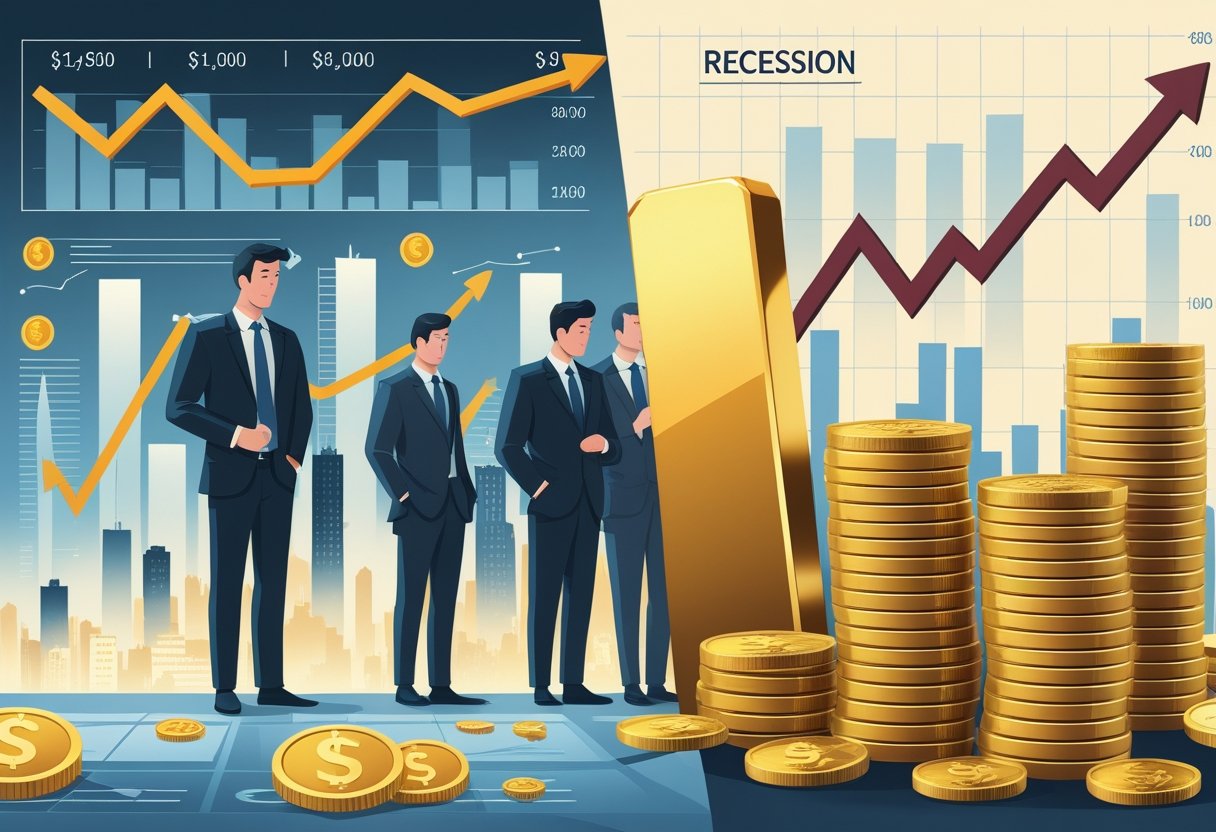
Recessions affect gold prices through shifts in economic conditions, investor reactions, and gold’s role in financial markets. Changes in demand, market uncertainty, and risk management strategies during downturns shape gold’s price movements.
Economic Downturns and Gold Demand
During recessions, economic growth contracts, and inflation can become unpredictable. This often leads to increased demand for gold as a store of value. Supply chains and production costs for gold remain relatively stable, which contributes to its rising price in these periods.
Gold demand usually rises because other investments, like equities, tend to decline. Additionally, central banks might increase gold reserves to diversify assets. This combination of higher demand and stable supply enhances gold’s price support during economic slowdowns.
Investor Behavior During Recessions
Investors typically shift capital away from volatile assets and toward safer options during recessions. Many prioritize liquidity and low-risk holdings, which increases the appeal of gold. The metal is often included in portfolios to mitigate losses from stock market downturns.
Behavioral trends show that purchases of physical gold, gold ETFs, and futures contracts increase. Investors see gold as a way to hedge against market instability and preserve wealth. However, gold prices don’t always rise uniformly; they can be influenced by factors like interest rates and currency strength.
Gold as a Safe Haven Asset
Gold’s reputation as a safe haven comes from its historical performance in times of financial stress. Investors rely on gold to protect purchasing power when conventional currencies face devaluation or inflation.
Because gold is not tied to any single economy, it offers diversification benefits. This makes it a preferred choice when confidence in financial systems drops. The metal’s price often moves inversely to the stock market and government bonds during recessions, reinforcing its role as a defensive asset.
Historical Performance of Gold in Recessionary Periods
Gold’s behavior during recessions varies but generally shows resilience compared to other assets. Its price often rises amid economic uncertainty, reflecting its status as a store of value. Historical data and comparisons highlight patterns that investors find useful in turbulent times.
Gold Price Trends in Previous Recessions
Gold prices have typically increased or remained stable during recessions. For example, during the 1970s stagflation, gold sharply rose as inflation surged while the economy contracted. In the 2008 financial crisis, gold’s price climbed as investors sought safety from collapsing stock markets.
However, the response is not uniform. In some recessions, gold’s price has shown volatility, influenced by factors like interest rate changes, currency strength, and government policies.
Key factors influencing gold prices during recessions include:
- Inflation or deflation trends
- Central bank monetary policy
- Investor demand for safe assets
Comparing Gold to Other Asset Classes
Gold often acts as a hedge against losses in equities and bonds during recessions. Unlike stocks, which generally fall due to reduced corporate earnings, gold usually holds or gains value. Bonds may benefit from lower interest rates but can be affected by credit risk.
Gold’s low correlation to the S&P 500 enhances its appeal as a portfolio diversifier. While real estate may decline due to reduced spending and credit availability, gold typically faces less direct impact.
Investors often view gold as a liquidity refuge when financial markets experience stress.
Case Studies of Major Recessions
During the 2008 global recession, gold’s price rose about 25% as confidence in financial institutions faltered. Its appeal increased amid widespread stock market uncertainty and credit freezes.
In contrast, the early 1990s recession saw more modest gold price increases, partly because inflation was low and central banks were not aggressively easing monetary policy.
The 1970s recession combined high inflation and recession, leading gold to perform exceptionally well. Its price surged from under $40 an ounce in early 1970 to over $800 by 1980.
These examples show that gold’s performance depends heavily on the specific economic environment driving each recession.
Key Factors Driving Gold Prices in a Recession

Gold prices during recessions are influenced by several key economic and financial dynamics. These factors include central bank actions, shifts in inflation expectations, and movements in currency values. Understanding these helps clarify why gold often behaves as it does during economic downturns.
Monetary Policy Responses
Central banks typically respond to recessions with policy measures aimed at stabilizing the economy. They often lower interest rates to encourage borrowing and investment. This reduction in yields makes non-interest-bearing assets like gold more appealing to investors.
In addition to rate cuts, central banks may engage in quantitative easing, increasing the money supply. This action can raise concerns about future inflation and weaken confidence in paper currencies. As a result, demand for gold as a store of value tends to rise.
Monetary policy clarity or uncertainty impacts gold prices, too. When central banks communicate clearly and decisively, markets may react less strongly. However, unexpected or aggressive policy moves often drive gold price volatility.
Inflation and Deflation Concerns
Inflation expectations are a major driver of gold prices in recessions. If a recession is accompanied by fears of rising inflation, gold tends to increase as a hedge against eroding purchasing power. Investors seek protection against the loss of real value in cash assets.
Conversely, if a recession triggers deflation, where prices fall, gold may lose some appeal. In deflationary environments, real interest rates can remain high or increase, favoring cash or bonds over gold.
The dual possibility of inflation or deflation during recessions creates complex dynamics. Gold’s role depends on which expectation dominates investors’ minds, often influenced by central bank signals and economic data.
Currency Fluctuations and Gold Valuation
Gold is priced in U.S. dollars globally, making currency movements critical. During recessions, the dollar often strengthens as a safe-haven currency. A stronger dollar tends to put downward pressure on gold prices for holders of other currencies because gold becomes more expensive in those currencies.
However, prolonged economic stress or expansive monetary policies can weaken the dollar. When this happens, gold prices typically rise because gold becomes cheaper for holders of other currencies, boosting demand.
Fluctuations in currency values create a direct relationship with gold valuation. Investors must monitor exchange rates closely, as changes can amplify or mitigate gold price movements during recessions.
Risks and Volatility of Gold During Recessions

Gold often draws attention as a safe haven during economic downturns, but its price movements and risks are not uniform. Factors like trading liquidity, time horizons, and external pressures can all influence how gold performs during recessions.
Market Liquidity and Gold Trading
During recessions, liquidity in financial markets can shrink sharply. This liquidity contraction affects gold trading because investors may sell gold rapidly to raise cash, especially in severe downturns.
Reduced market liquidity can cause wider bid-ask spreads, increasing trading costs and price volatility. In times of crisis, gold’s usual role as a stable asset can be disrupted if investors prioritize cash over bullion.
Physical gold markets can also face bottlenecks, with delays in delivery and premiums on coins or bars. These frictions add to the complexity and may trigger short-term swings in gold prices, despite its long-term appeal.
Short-Term vs. Long-Term Price Movements
Gold prices can be volatile over short periods during a recession due to investor sentiment shifts and market dynamics. Rapid moves in stocks and bonds often spill over into gold, causing sharp price fluctuations.
In the longer term, gold generally benefits from recessionary pressures like inflation and currency weakness. Historical data show gold often outperforms equities across the entire recession period, though price surges may not be immediate.
Investors should recognize that short-term corrections in gold are common and do not necessarily indicate a breakdown in its role as an economic hedge.
Potential Downward Pressures on Gold
Several factors can push gold prices lower during recessions. Rising real interest rates can reduce gold’s appeal since it yields no interest or dividends.
A strong U.S. dollar typically weighs on gold prices because gold is dollar-denominated and more expensive for foreign buyers. Central bank policies, such as quantitative easing or tapering, also influence these dynamics.
Additionally, if investor risk appetite increases mid-recession due to positive economic signals, capital may flow out of gold toward higher-yielding assets, creating price pressure on the metal.
Investment Strategies for Gold in Economic Downturns
Investors should carefully choose how to hold gold, balance it within a broader portfolio, and decide when to buy during a recession. Each approach affects liquidity, risk, and long-term value differently. Understanding these factors helps investors protect wealth and optimize gains amid economic uncertainty.
Physical Bullion vs. Gold Securities
Physical bullion includes gold bars and coins. It offers direct ownership and protection against counterparty risk. However, it requires secure storage and insurance, which can add costs. Physical gold can be less liquid, especially in smaller amounts or non-standard forms.
Gold securities, like ETFs or mining stocks, are easier to trade and provide exposure without handling metal. ETFs track gold prices closely, while mining stocks may carry additional risks tied to company performance and operations. Securities typically have lower upfront costs but face market volatility and management fees.
Investors must weigh security, liquidity, and expenses when choosing between physical gold and gold-based financial products.
Portfolio Diversification Approaches
During recessions, gold often behaves differently than stocks or bonds, making it a useful diversification tool. Adding gold can reduce overall portfolio volatility and serve as a hedge against inflation or currency devaluation.
Recommended allocation to gold varies but often ranges between 5% and 15% of total assets, depending on risk tolerance. Portfolio diversification benefits increase when gold holdings balance exposure to traditional equities and fixed income.
It is important to regularly rebalance to maintain target gold exposure, especially during economic shifts that impact asset correlations.
Timing Gold Purchases in a Recession
Timing purchases can significantly affect returns. Gold prices often rise early in a recession as investors seek safety. However, prices can dip during brief recoveries or when liquidity demands increase.
A dollar-cost averaging approach helps mitigate timing risks by spreading purchases over time. Investors should monitor economic indicators such as inflation rates, central bank policies, and market sentiment to inform buying decisions.
Waiting for market corrections or signs of sustained economic stress may enhance entry points without missing out on long-term gains.
Global Events and Their Impact on Gold Prices in Recession
Gold prices during recessions are influenced by multiple global factors beyond the recession itself. These include geopolitical tensions, monetary policies enacted by central banks, and shifting patterns of international demand. Each factor plays a distinct role in shaping gold’s market behavior.
Geopolitical Uncertainty
Geopolitical instability typically increases investor demand for gold as a safe-haven asset. Conflicts, territorial disputes, and political unrest create doubt in traditional markets. This uncertainty often drives gold prices up even as economic activity contracts.
However, the extent of price movement depends on the nature and duration of the conflict. Short-term tensions may cause brief spikes, while prolonged instability encourages sustained gold investment. For instance, periods marked by international sanctions or war have historically elevated gold values despite broader economic recessions.
Central Bank Policies Worldwide
Central banks influence gold prices significantly through interest rate adjustments and monetary easing programs. During recessions, they often lower rates or implement quantitative easing to stimulate economies. These policies usually reduce the opportunity cost of holding non-yielding assets like gold.
Lower interest rates weaken fiat currencies, making gold more attractive as a store of value. Conversely, if central banks signal aggressive tightening or dollar strength, it can dampen gold prices, even in recessionary environments. The interaction between central bank actions and investor expectations shapes short- and long-term gold price trends.
International Demand Shifts
Gold demand varies across global regions, affecting its price during recessions. Emerging markets, particularly in Asia, maintain strong physical gold purchases for cultural and investment reasons. Economic slowdowns in these areas can reduce demand, putting downward pressure on prices.
Conversely, increased buying by institutional investors or sovereign wealth funds can offset this effect. Jewelry and industrial uses fluctuate less with recessions but still contribute to overall demand. Understanding these geographic and sectoral shifts helps explain gold price volatility in a global recession context.
| Factor | Impact on Gold Prices | Example |
|---|---|---|
| Geopolitical Uncertainty | Drives safe-haven buying, price spikes | Wars, sanctions |
| Central Bank Policies | Influences opportunity cost, currency value | Rate cuts, QE programs |
| International Demand | Alters total physical and investment demand | Asia’s buying behavior |
Future Outlook for Gold Prices in Potential Recessions
Gold often benefits from increased demand during economic downturns as investors seek safe-haven assets. This pattern is supported by historical data showing gold prices either stabilizing or rising when markets face uncertainty.
However, gold’s performance is not guaranteed in every recession. Factors such as interest rate changes, inflation expectations, and investor sentiment influence its price direction. For example, rising interest rates may reduce gold’s appeal since it does not yield interest.
Geopolitical risks and policy uncertainty also affect gold prices. In times of global instability, gold tends to attract more investment, which can push prices higher even if the economy shows signs of slowing.
| Factor | Impact on Gold Prices |
|---|---|
| Inflation concerns | Typically positive |
| Rising interest rates | Often negative |
| Geopolitical uncertainty | Positive |
| Strong US dollar | Negative |
Analysts project that gold could continue to rally amid potential recessions, especially if inflation remains elevated and geopolitical tensions persist. Nevertheless, short-term price corrections are possible if market conditions improve or if risk appetite returns.
Investors considering gold during future recessions should monitor economic indicators closely. Balancing these factors helps in determining the timing and scale of gold investments during economic downturns.