Gold and the S&P 500 have both played important roles in investment portfolios, but their performance often differs depending on economic conditions. Over the past few decades, gold has at times outperformed the stock market, particularly during periods of financial uncertainty or market downturns. However, stocks generally offer higher long-term growth through dividends and corporate earnings.
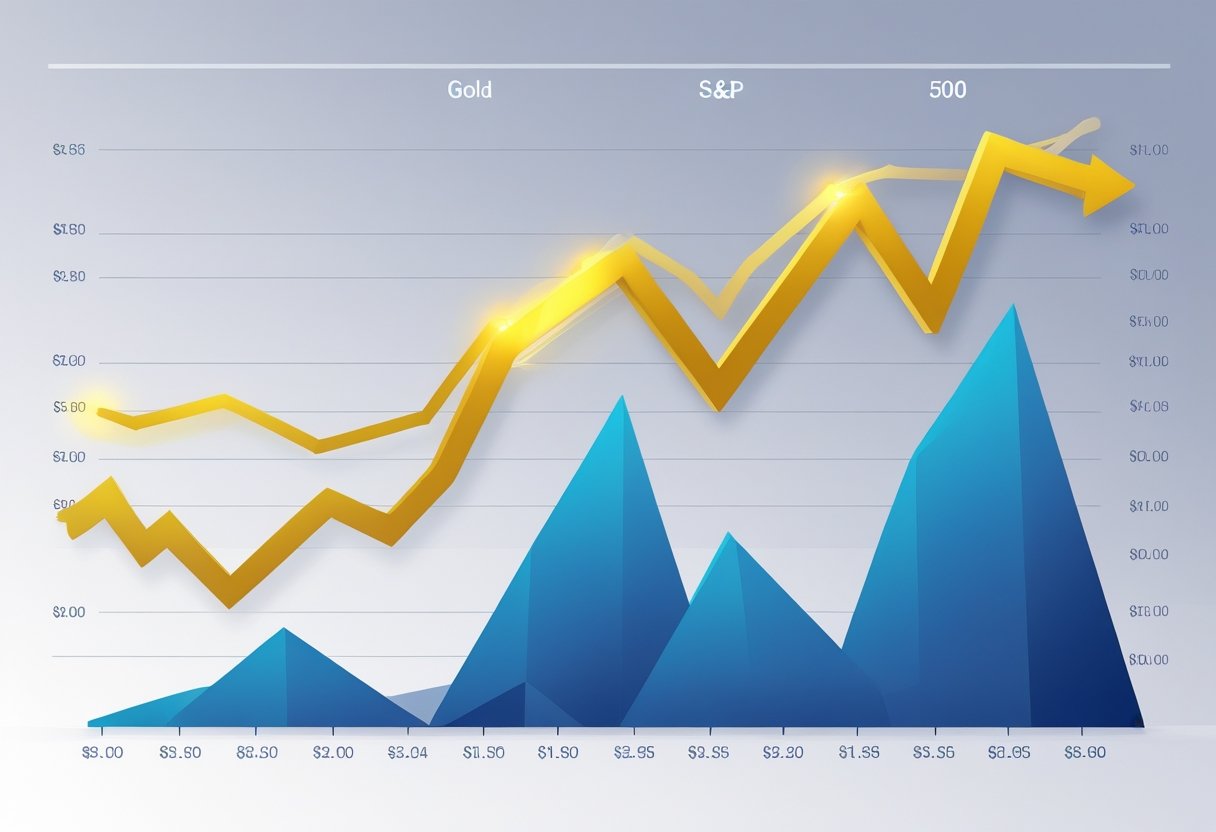
Over the last 30 years, gold has slightly outpaced the S&P 500 with a notable surge since 2000, but the two assets tend to behave differently, serving distinct purposes in a diversified portfolio. For example, between 2000 and 2010, gold significantly outperformed stocks, while the S&P 500 showed stronger gains in many other periods. Recent years have seen both investments deliver strong returns, with gold and stocks posting gains above 25% in 2024.
Investors often debate whether to favor gold or the S&P 500, depending on their goals and risk tolerance. Understanding their historical performance, volatility, and reaction to market shifts helps clarify when each asset may be more advantageous. This blog post will explore these dynamics and provide insight into how gold’s price compares to the S&P 500 over time.
Gold’s Price Performance Versus the S & P 500
Gold and the S&P 500 have shown distinct performance patterns over time. Their returns differ depending on economic conditions, with gold often acting as a hedge during stock market declines. Volatility levels and key time periods reveal when one asset outperformed the other significantly.
Historical Price Trends
Over the last several decades, the S&P 500 has delivered stronger average annual returns compared to gold. Since 1971, when the gold standard ended, stocks generally outpaced gold, reflecting longer-term economic growth and corporate earnings expansion.
However, gold demonstrated better returns during periods of economic uncertainty and high inflation. For example, between 2000 and 2010, gold’s price surged, while the S&P 500 remained relatively flat or declined at times. In recent years, both assets have delivered strong returns simultaneously, such as in 2024 when gold rose 27% and the S&P 500 gained 25%.
Volatility Comparison
Gold typically exhibits lower volatility than stocks during market downturns, making it a preferred asset for risk-averse investors. The S&P 500’s price swings are generally larger and more frequent, driven by corporate earnings and market sentiment.
During nine years when the S&P 500 posted negative returns, gold outperformed in eight of those years, averaging about 19.4% returns compared to -15.3% for stocks. This demonstrates gold’s function as a diversifier, exhibiting smoother performance in turbulent markets.
Key Periods of Divergence
The most notable divergence occurred from 2000 to 2010, highlighted by the dot-com bust and the 2008 financial crisis. Gold’s price increased steadily, while the S&P 500 experienced significant losses and volatility.
Another period was the 1970s, when rampant inflation pushed gold prices sharply higher while stocks struggled. Conversely, during long bull markets, such as the 1980s and 1990s, stocks outperformed gold by substantial margins.
These periods illustrate how shifts in inflation, economic growth, and investor sentiment can cause one asset to outperform the other significantly.
Factors Influencing Gold and S & P 500 Returns
Gold and the S&P 500 respond to different but sometimes overlapping economic factors. Their returns are shaped by inflation trends, interest rates, investor confidence, and geopolitical developments. Understanding these forces helps explain the varying performance of these assets over time.
Macroeconomic Drivers
Inflation is a primary driver in the relative performance of gold and the S&P 500. Gold is often seen as a hedge against inflation, as its price tends to rise when inflation accelerates or when real interest rates fall. Conversely, high inflation can erode corporate profits, negatively impacting stock valuations in the S&P 500.
Economic growth rates also play a role. Strong growth boosts corporate earnings, lifting stock prices. However, during economic slowdowns or recessions, gold’s appeal as a safe haven strengthens. Commodity prices, currency fluctuations, and wage pressures further influence inflation and growth expectations, affecting both markets.
Monetary Policy Impact
Central bank decisions on interest rates are crucial for both gold and equities. When central banks raise interest rates to combat inflation, bond yields tend to rise, making non-yielding assets like gold less attractive. Stocks may also face headwinds due to higher borrowing costs.
Conversely, in a low or declining interest rate environment, gold often benefits due to reduced opportunity costs. The S&P 500 may also rally as cheap credit supports business expansion and consumer spending. Quantitative easing and other unconventional measures boost liquidity, which can lift asset prices broadly, including gold and stocks.
Global Events and Market Sentiment
Geopolitical tensions, trade disputes, and financial crises tend to increase uncertainty, leading investors to seek safe havens like gold. For example, periods of market turbulence or geopolitical conflict have historically resulted in gold price surges.
Stock markets, including the S&P 500, are sensitive to shifts in investor sentiment driven by global events. Positive developments can fuel optimism and market rallies, while fear of conflict or economic disruption can cause sharp sell-offs. Sentiment and risk appetite create short- to medium-term fluctuations influencing both asset classes but often in opposite directions.
Risk and Return Profiles
Gold and the S&P 500 present distinct risk and return characteristics that impact investment decisions. Understanding their growth potential, diversification benefits, and historical drawdowns is essential for evaluating their roles in a portfolio.
Long-Term Growth Potential
The S&P 500 has demonstrated stronger long-term growth compared to gold, driven by corporate earnings and economic expansion. Historically, the stock index has delivered average annual returns of about 7-10% after inflation since the 1970s. Gold, while it has preserved wealth, generally offers lower long-term returns, with periods of outperformance often tied to inflation spikes or market turmoil.
Volatility in the S&P 500 is higher, meaning returns can fluctuate significantly year to year. Gold provides steadier price movements but lacks the consistent upward trend seen in equities. Investors seeking capital appreciation typically favor the S&P 500 for its compounded growth ability over decades.
Portfolio Diversification
Gold functions as a non-correlated asset relative to the S&P 500. It tends to retain value during equity market downturns and geopolitical crises. This low correlation makes gold a strategic choice to reduce overall portfolio risk and improve stability.
Including gold can reduce portfolio volatility and provide downside protection. It acts as an inflation hedge and store of value, balancing the growth-oriented nature of stocks. Most financial experts recommend allocating a modest percentage, often 5-15%, to gold for effective diversification, depending on the risk tolerance and investment horizon.
Drawdown Analysis
The S&P 500 has experienced significant drawdowns, including the 2008 financial crisis and the dot-com crash, with losses exceeding 40% in some cases. These periods often required several years for full recovery. Despite this, the index has rebounded strongly in subsequent recoveries.
Gold’s price dips are generally less severe during stock market crashes. For example, between 2000 and 2010, gold outperformed while equities struggled. However, it can also face steep declines during times when investor confidence shifts back to growth assets.
| Asset | Typical Max Drawdown | Recovery Period | Volatility |
|---|---|---|---|
| S&P 500 | 30-50% | 2-5 years | High |
| Gold | 20-30% | 1-3 years | Moderate |
This comparison highlights gold’s role as a risk mitigator during severe equity downturns but confirms stocks’ superior growth potential over time.
Investment Strategies Incorporating Gold and the S & P 500
Combining gold and the S&P 500 in an investment portfolio requires balancing growth potential with risk management and inflation protection. Investors can use different allocation methods to optimize returns while limiting volatility. This involves mixing fixed long-term targets, flexible market-driven shifts, and leveraging gold’s characteristics during inflationary periods.
Strategic Asset Allocation
This strategy involves setting fixed percentage targets for gold and S&P 500 holdings based on an investor’s risk tolerance and time horizon. For example, a moderate portfolio might allocate 70% to the S&P 500 for growth and 30% to gold for stability.
Such allocations aim to provide diversification benefits. Gold typically has low correlation with stocks, which can reduce overall portfolio volatility. Periodic rebalancing ensures the portfolio stays aligned with the original plan.
A common range for gold is 5-15%, but in times of uncertainty, some investors increase exposure to 20-30%. This approach emphasizes long-term discipline over reacting to short-term market moves.
Tactical Allocation Approaches
Tactical allocation involves actively shifting the balance between gold and the S&P 500 based on economic indicators or market conditions. Investors may increase gold holdings during geopolitical tensions or financial instability when gold tends to outperform.
Conversely, in strong bull markets for equities, funds can be moved back toward the S&P 500 to capture growth opportunities. This dynamic switching strategy requires ongoing market analysis and quick decision-making.
Some use technical signals or economic data like interest rates, inflation expectations, and stock market valuations to time allocations. This method can improve returns and risk control but also carries higher transaction costs and complexity.
Inflation Hedging
Gold’s primary appeal in portfolios is its historical role as a hedge against inflation. Unlike stocks, which can suffer during rising inflation, gold often maintains or increases its purchasing power.
During inflationary periods, gold prices typically rise as investors seek a store of value, protecting real wealth. In contrast, the S&P 500’s real returns may be eroded if corporate earnings and dividends don’t keep pace with inflation.
Incorporating gold for inflation protection means holding it as a counterbalance to stocks, especially when inflation expectations increase. The allocation size may vary based on inflation forecasts but generally ranges from 10-20%. This strategy supports portfolio resilience against loss of purchasing power.
Correlation and Diversification Benefits
Gold exhibits a distinct relationship with the S&P 500 that influences portfolio construction. This relationship varies over time, sometimes moving inversely or showing minimal correlation, which can affect risk and return profiles.
Inverse and Low Correlation Periods
Gold and the S&P 500 frequently exhibit low or near-zero correlation. This means their price movements often occur independently. During stock market declines, gold has occasionally moved inversely, increasing in value as equities drop, particularly in times of economic uncertainty or inflationary pressures.
From 2000 to 2010, gold notably outperformed when the S&P 500 underperformed, reflecting its role as a safe-haven asset. Such periods highlight gold’s capacity to act as a hedge against equity market risks, providing a buffer when stocks face volatility or downturns.
Impact on Portfolio Volatility
Including gold in a portfolio with S&P 500 stocks can reduce overall volatility. This is due to the differing market drivers affecting each asset, where gold tends to maintain or increase value during times of market stress.
Portfolios mixing gold and equities can achieve improved risk-adjusted returns, often measured by higher Sharpe Ratios. This diversification benefit comes from spreading exposure across uncorrelated assets, helping to smooth returns and reduce potential losses during stock market declines.
Market Sentiment and Behavioral Trends
Investor behavior toward gold and the S&P 500 often reflects contrasting attitudes about economic conditions and risk. Sentiment around gold tends to peak during uncertainty, while equity sentiment thrives on optimism. These opposing forces shape market flows and asset prices.
Safe Haven Investing
Gold is widely recognized as a safe haven asset, attracting investors during periods of economic stress or market volatility. When the S&P 500 faces declines or heightened risk, investors often allocate capital to gold to preserve wealth and hedge against inflation or currency depreciation.
This behavior is evident in the significant rally gold experienced as the S&P 500 dropped by 3.5% in early 2025. The increase in gold prices above $3,000 per ounce aligns with rising concerns about inflation and expectations of U.S. interest rate cuts, both of which tend to weaken the dollar and boost gold demand.
The divergent sentiment—optimism toward equities versus pessimism about economic stability—drives notable shifts between these assets. Gold’s appeal intensifies when investors prioritize capital preservation over growth.
Momentum and Speculation
Momentum and speculative trading impact both gold and the S&P 500, though the dynamics differ. Equity markets often see rapid shifts driven by earnings reports, economic data, and geopolitical developments. Positive momentum can trigger rallies, while speculation can amplify volatility.
In contrast, gold’s price momentum is typically linked to monetary policy expectations and currency movements. Speculative interest may rise when traders anticipate central bank actions—such as rate cuts—that reduce real yields and increase gold’s attractiveness.
Despite gold’s role as a safe haven, speculative flows can cause short-term price spikes, especially during periods of heightened uncertainty. The interplay between momentum-driven buying in stocks and gold alike contributes to alternating dominance in returns over short and medium terms.
Future Outlook for Gold and the S & P 500
Gold is expected to maintain strong momentum into 2026. Analysts forecast a potential price surge of up to 20%, driven by central bank buying and anticipated Federal Reserve rate cuts. Geopolitical tensions and economic uncertainty continue to support gold’s appeal as a safe-haven asset.
The S & P 500, while historically a reliable wealth creator, faces potential headwinds. Some indicators suggest a downward reversion from its multi-decade highs relative to GDP and global index benchmarks. However, equities benefit from dividends and compounding, which tend to favor long-term growth despite short-term volatility.
Investors weighing gold against the S & P 500 should consider key factors:
- Gold offers inflation protection and a hedge during market turbulence.
- Equities provide growth through earnings and dividend reinvestment over time.
In 2024 and 2025, both gold and the S & P 500 delivered strong returns, with gold slightly outperforming. This parallel performance reflects a rare alignment of market conditions that may not persist.
| Metric | Gold (2004-2024) | S & P 500 (2004-2024) |
|---|---|---|
| Total Return | 543% | 482% |
| 2024 Return | 27% | 25% |
| 2025 Return | ~48% | Moderate |
Market dynamics remain fluid. Gold’s role as a portfolio diversifier remains significant, especially amid inflation fears and geopolitical risks. Stocks continue to offer growth, but may face increased volatility as economic conditions evolve.