Investing in precious metals ETFs is often seen as a convenient and cost-effective alternative to buying physical metals. While these funds offer liquidity and eliminate storage hassles, many investors overlook the less obvious expenses that can erode returns over time. The hidden costs of precious metals ETFs—such as management fees, transaction costs, and the impact of derivatives—can significantly affect overall investment performance.

These expenses are not always transparent and may vary widely between different ETFs. Beyond the advertised expense ratios, investors should consider factors like bid-ask spreads, tracking errors, and potential fees related to futures contracts or other financial instruments used by the fund. Recognizing these hidden costs is essential for making informed decisions in a market where every percentage point counts.
Understanding Precious Metals ETFs

Precious metals ETFs provide a way to invest in metals like gold or silver without owning physical bullion. They operate through different structures and strategies that affect liquidity, cost, and exposure. Comparing popular ETFs reveals key differences in holdings, fees, and risk profiles.
How Precious Metals ETFs Work
Precious metals ETFs track the price of metals by holding physical bullion, futures contracts, or shares in mining companies. Investors buy shares on stock exchanges, gaining exposure without handling metal storage or insurance.
These funds offer liquidity similar to stocks, allowing investors to enter or exit positions quickly. However, some ETFs track futures, which introduces roll costs and time decay that can reduce returns over time.
Expense ratios and management fees vary, directly impacting net performance. Investors should also consider tax treatment, as gains from physical metal ETFs may be taxed differently than stock-based ETFs.
Types of Precious Metals ETFs
There are three main types of precious metals ETFs:
Physical-backed ETFs: Hold actual metal bars stored in vaults. Examples include SPDR Gold Shares (GLD) and iShares Silver Trust (SLV). They closely track spot prices but have storage fees.
Futures-based ETFs: Invest in metal futures contracts rather than physical assets. These include ETFs like Aberdeen Standard Physical Palladium Shares. They face potential roll costs when contracts expire.
Equity-based ETFs: Hold shares of mining companies instead of metals. Such funds provide indirect exposure and may include operational risks tied to the firms themselves, impacting performance beyond metal prices.
Each type carries distinct risks, costs, and potential tax implications that affect long-term returns.
Popular Precious Metals ETFs Compared
| ETF Symbol | Type | Expense Ratio | Key Focus | Notes |
|---|---|---|---|---|
| GLD | Physical-backed | 0.40% | Gold bullion | High liquidity, direct metal exposure |
| SLV | Physical-backed | 0.50% | Silver bullion | Popular for silver, storage fees apply |
| PPLT | Physical-backed | 0.60% | Platinum | Less liquid, niche metal |
| GDX | Equity-based | 0.52% | Gold mining stocks | Performance tied to mining companies |
| PALL | Futures-based | 0.60% | Palladium futures | Roll costs can erode gains |
Comparing these funds highlights trade-offs among costs, liquidity, and exposure type. Investors need to weigh the specific ETF structure against their investment goals and risk tolerance.
Management Fees and Expense Ratios

Investors in precious metals ETFs face ongoing costs that can reduce returns and affect long-term gains. These costs include annual management fees charged for fund administration and additional expenses embedded within the fund’s expense ratio. Understanding these fees is essential for realistic performance expectations.
Annual Management Costs
Annual management costs, often expressed as a management fee, represent the percentage of the fund’s assets paid to the fund manager each year. These fees typically range from 0.25% to 0.75% for precious metals ETFs, though some funds may charge more or less.
The management fee covers portfolio management, administrative tasks, and operating expenses. Importantly, it is deducted automatically, so investors do not pay it directly but experience its impact through reduced net asset value.
Lower management fees generally benefit long-term investors by preserving more investment capital. However, fees should not be the only factor when choosing an ETF; fund strategy and performance consistency also matter.
Hidden Charges in Expense Ratios
Expense ratios provide a broader measure of the total costs associated with an ETF, including the management fee plus other operating expenses such as legal, auditing, and custodial fees. These are expressed annually as a percentage of assets under management.
Some ETFs also include indirect expenses like transaction costs and securities lending fees within their expense ratios. These hidden charges can vary by fund and are not always transparently disclosed.
Investors should carefully review the total expense ratio (TER) to understand the full cost burden. It’s common for precious metals ETFs to have TERs between 0.30% and 1.00%, depending on the fund’s structure and management style.
How Fees Compound Over Time
Even small fees can have a significant cumulative effect on returns over many years. For example, a 0.5% annual fee may seem minor but, compounded annually, it can erode a substantial portion of investment gains.
Consider an investor with $10,000 investing in an ETF with a 0.5% expense ratio and an average net return of 5% annually before fees. After 20 years, fees could reduce the final amount by thousands of dollars.
This compounding cost makes fee consideration crucial, especially for long-term, buy-and-hold investors. Minimizing fees is one of the few controllable factors that can improve overall portfolio performance.
Tracking Error and Performance Risks
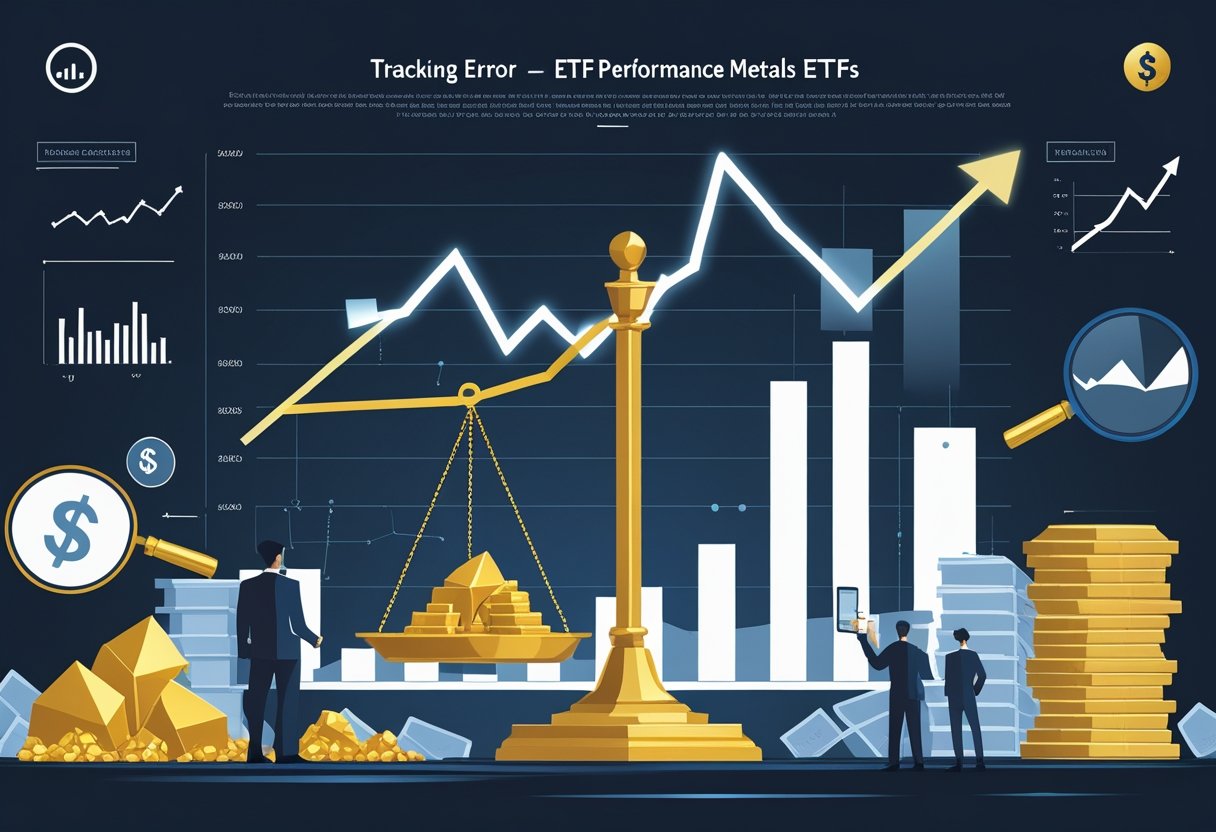
Precious metals ETFs often do not perfectly mirror the prices of their underlying assets. Various factors cause deviations in performance, which can affect the returns investors actually receive compared to metal price movements.
What Is Tracking Error?
Tracking error is the measure of how much an ETF’s returns deviate from the returns of its target index or underlying metal price. It quantifies the gap between the fund’s performance and the benchmark it aims to replicate.
This deviation occurs even if the fund is designed to closely follow the metal prices. Tracking error is typically expressed as a percentage and calculated over a set period, such as daily, monthly, or annually. Small tracking errors are common but still reduce potential gains for investors over time.
Sources of Performance Divergence
Several factors cause discrepancies between an ETF’s returns and the underlying metal’s price.
- Management fees and expenses: These reduce overall fund returns and are deducted before returns are reported.
- Trading costs: Frequent buying and selling within the ETF can generate expenses that affect performance.
- Use of derivatives: ETFs that use futures contracts instead of holding physical metals face risks such as roll costs and price contango.
- Cash holdings: Funds may keep cash for liquidity, which can lag behind metal price movements.
- Market liquidity and timing: Delays or inefficiencies in trading can cause slight performance differences.
These elements combine to create a tracking gap, which varies across ETFs and market conditions.
Impact on Investor Returns
Tracking error can have a meaningful impact on long-term returns. Even minor persistent discrepancies compound over time, reducing the total investment growth.
Investors expecting returns identical to the metal price may be misled if they ignore tracking errors. For example, a 0.5% annual tracking error may seem small but can significantly erode gains over multiple years.
Understanding tracking error helps in selecting ETFs with lower performance risk. Investors should review fund details like fee structures and whether the ETF holds physical metals or derivatives to mitigate unexpected shortfalls.
Liquidity and Trading Pitfalls

Liquidity in precious metals ETFs is often assumed to be straightforward, but there are nuances that can affect trading costs and execution quality. Investors face challenges such as wider bid-ask spreads and discrepancies between market prices and the underlying asset values.
Bid-Ask Spreads in Precious Metals ETFs
Bid-ask spreads represent the difference between the highest price buyers are willing to pay and the lowest price sellers accept. For precious metals ETFs, these spreads can widen significantly during periods of market volatility or low trading volume.
Wider spreads increase transaction costs and reduce overall returns. Even popular ETFs can experience spread fluctuations during market stress, impacting the ease of entering or exiting positions quickly and at expected prices.
Liquidity depends not only on the ETF’s trading volume but also on the liquidity of the underlying metals. Some metals, like platinum and palladium, tend to have less active markets than gold or silver, which can exacerbate spreads for funds focused on these metals.
Premiums and Discounts to Net Asset Value
Precious metals ETFs can trade at premiums or discounts relative to their net asset value (NAV), which reflects the value of the underlying metals. This difference arises when market demand or supply for ETF shares diverges from the actual metal prices.
A premium means investors pay more than the NAV, increasing the effective cost of the investment. Conversely, a discount may signal selling pressure or liquidity problems, potentially presenting risks for shareholders when redeeming shares.
The premium or discount can fluctuate daily and may be influenced by factors like currency exchange rates, particularly when ETFs trade in U.S. dollars but hold metals priced internationally. This can add hidden currency conversion costs that are not immediately visible to investors.
Tax Implications Often Overlooked
Investors often underestimate the way taxes impact returns on precious metals ETFs. Certain tax rules significantly affect gains and differ from those applied to physical metals. Understanding these nuances can help manage tax exposure effectively.
Capital Gains Triggers
Precious metals ETFs are subject to capital gains taxes when sold. Unlike typical stocks, gains on these ETFs are taxed at a maximum rate of 28%, classified as collectibles by the IRS.
This rate applies whether the investment is held short-term or long-term, which is higher than the typical capital gains tax on stocks. Frequent trading within these ETFs may trigger multiple taxable events, increasing the investor’s tax burden.
Investors should track purchase and sale dates carefully and plan strategies to minimize taxable transactions to avoid unexpected tax liabilities.
Tax Inefficiencies Versus Physical Metals
Physical metals like gold and silver have different tax rules. Gains on physical metals are also collectible property and taxed at 28%, but investors can defer taxes by holding the metal without selling.
ETFs, however, may distribute gains annually due to fund activities, causing taxable events even without selling shares. This passive tax drag reduces overall returns compared to physical holdings.
Additionally, ETFs may generate capital gains distributions, complicating tax reporting and reducing tax efficiency. Physical metal ownership offers direct control over when gains are realized and taxed, which some investors prefer.
Custodial and Counterparty Risks
Investing in precious metals ETFs involves risks related to how the assets are held and the reliability of the parties managing them. These risks can affect both the security and accessibility of the investor’s holdings.
Storage and Insurance Limitations
Most precious metals ETFs rely on third-party custodians to store the physical metals backing the fund. However, the investor rarely has direct access or control over these metals. Storage facilities may impose limits on insurance coverage, leaving some assets underinsured against theft, damage, or loss.
Additionally, costs related to secure storage and insurance are often baked into ETF fees but are not always transparent. Investors should verify if the custodian’s insurance fully covers the value of their allocated metals and understand the protocols for claiming losses in adverse events.
Counterparty Failures and Bankruptcy Risks
ETFs also carry counterparty risk because if the issuer, custodian, or related financial entities fail, investors may face delays or losses. Bankruptcy of the fund provider or custodian can complicate the redemption of shares back into physical metals or cash.
Certain ETFs use derivatives or synthetic replication, increasing exposure to counterparty defaults beyond physical storage risks. Even ETFs holding physical metals face risks from the solvency and operational integrity of custodians and administrators. Investors must assess these entities’ financial health and legal protections in place.
Synthetic Versus Physical ETFs: Hidden Drawbacks
Synthetic and physical precious metals ETFs differ not only in structure but also in risks and transparency issues. These hidden drawbacks can significantly impact investors’ portfolios beyond typical fees and performance metrics.
Risks of Synthetic ETF Structures
Synthetic ETFs use derivatives like swaps to replicate the performance of an asset instead of holding the physical metal. This introduces counterparty risk, where the financial institution providing the swap could fail to meet its obligations.
Additionally, liquidity risks tend to be higher in synthetic ETFs, especially if the derivatives market tightens or counterparties withdraw. This can affect the ability to redeem shares at fair value.
While synthetic ETFs often reduce tracking errors compared to physical ETFs, investors bear the risk of complex derivative contracts and collateral management failures. This complexity may not suit investors seeking straightforward, tangible asset exposure.
Collateral Transparency Issues
Synthetic ETFs typically use collateral to back derivative contracts. However, the exact nature and quality of this collateral can be obscured by fund structures.
Limited transparency hampers investors’ ability to assess the true backing of their investment. Collateral may include other financial instruments that carry their own risks and may not be instantly liquid.
In contrast, physical ETFs hold actual precious metals stored and audited regularly, providing clearer ownership and security. Investors in synthetic funds must trust the fund manager’s reporting and collateral practices, increasing uncertainty around asset safety.
Redemption Complications and Barriers
Redeeming shares of precious metals ETFs for physical metal involves specific challenges. Investors must navigate limits on conversion processes and meet substantial minimum quantities, which can restrict flexibility and increase costs.
Difficulties Redeeming in Physical Metal
Many precious metals ETFs issue shares that represent physical holdings, but converting shares into actual metal is often complex. Redemption may require dealing directly with the ETF provider or authorized participants, not the average investor.
Physical delivery usually involves paperwork, waiting periods, and additional fees for shipping and insurance. This process is less straightforward than selling ETF shares on the market. Moreover, some ETFs restrict direct redemption to institutional investors, limiting retail investors’ access.
The physical metal received might also come in large, standard bars or coins, which could require further sale or storage arrangements, adding complications and expense.
Minimum Redemption Requirements
ETFs typically impose a minimum redemption amount to avoid frequent small-scale physical deliveries. This minimum can be as high as 100 ounces of gold or its equivalent value in other metals.
These thresholds ensure transaction efficiency but create barriers for smaller investors. The inability to redeem small quantities forces investors to hold shares longer or sell only on the open market, where bid-ask spreads and trading fees apply.
Minimum redemption sizes can also impact portfolio liquidity and flexibility, especially for investors seeking to rebalance or liquidate in smaller increments. Understanding these requirements is critical for assessing the true cost and convenience of holding precious metals ETFs.
Market Volatility and Liquidity Crises
Precious metals ETFs can face challenges when markets become volatile or liquidity tightens. Sudden price movements and market stress impact how these ETFs trade and how investors can access their value.
Price Gaps During High Volatility
During periods of high volatility, the price of precious metals ETFs can experience significant gaps between trading sessions. This occurs when underlying metal prices move sharply after market hours or due to rapid shifts in investor sentiment.
These gaps mean ETF prices may not fully track the spot price of the metals at all times. Investors trading during volatile periods could face unexpected losses if the ETF price changes suddenly once the market opens or closes.
Furthermore, liquidity can dry up, widening bid-ask spreads and increasing trading costs. This volatility can disrupt pricing efficiency, making ETFs less reliable for precise metal exposure in turbulent markets.
Limitations During Extreme Market Events
In extreme market stress or liquidity crises, ETFs face operational limits that physical metals do not. For instance, redemption mechanisms that allow selling shares for underlying metals may become delayed or restricted.
If the market for the metals or ETF shares becomes illiquid, large ETF holders might not be able to exit positions quickly without impacting prices. This limits an investor’s ability to use precious metals ETFs as a perfect hedge during a financial crisis.
Additionally, during these events, regulatory interventions or market halts may further restrict trading. Investors relying solely on ETFs might therefore face liquidity bottlenecks and delayed access to funds that physical bullion investors would avoid.
Conclusion
Precious metals ETFs offer ease of access and liquidity compared to physical metals. However, investors should be aware of ongoing costs like management fees and expense ratios, which can reduce overall returns over time.
Tracking errors are another factor that can cause ETFs to deviate from the actual price movement of the underlying metals. This gap may impact an investor’s expected performance, especially in volatile markets.
Physical handling, storage, and insurance costs are avoided by investing in ETFs, but investors sacrifice direct ownership. This distinction can be important for those seeking full control over their assets.
When choosing between ETFs and physical metals, investors must consider liquidity, cost structure, and investment goals. ETFs may suit those prioritizing convenience and tradeability. Physical metals may appeal to those valuing tangible ownership and long-term preservation.
A clear understanding of these hidden costs and risks allows investors to make better-informed decisions aligned with their financial strategies.