You should care about precious metals in 2026 because multiple, measurable forces—strong industrial demand, continued central bank buying, and restrained mine supply—converge to support higher prices and portfolio diversification. That combination makes 2026 a strategic year to consider adding or reallocating exposure to gold, silver, and other metals rather than waiting on a perfect entry.
Throughout the article you will see how macro drivers, supply-side limits, technological demand, and geopolitical uncertainty interact to create both opportunity and risk for metal investors. Expect clear, evidence-based takes on market drivers, mining developments, and the investment strategies that could position your holdings for the year ahead.
Rising Demand and Market Drivers
You will see demand growing from diverse sources: central banks, investors seeking portfolio diversification, industrial users, and jewelry markets. Supply constraints and strategic buying patterns are tightening available inventories, supporting prices.
Global Economic Uncertainty
You face a world of uneven growth and recurring geopolitical tensions that push capital toward tangible assets. When GDP forecasts weaken in major economies or trade disputes flare, central banks and sovereign wealth funds often increase gold reserves to reduce currency and credit exposure.
Retail and institutional flows respond quickly to risk spikes. For example, heavy central-bank purchases in 2025 and sizable retail interest show how buyers shift into metals during periods of market stress. Those flows can absorb available supply and create upward price pressure.
Supply-side risks amplify the effect. Mining output grows slowly due to long project lead times and underinvestment, while production disruptions from local conflicts or regulatory changes create episodic shortages that tighten markets further.
Inflation and Monetary Policy Trends
You should watch differing central-bank paths across regions. Where real interest rates stay negative or policy loosens, the opportunity cost of holding non-yielding metals falls, increasing demand for gold and silver as inflation hedges.
Expect continued demand from institutional investors reallocating portfolios to protect purchasing power. Forecasts from major banks projected further gold buying into 2026, reflecting expectations of persistent inflation and strategic reserve accumulation.
Currency volatility also matters. A weaker dollar often lifts dollar-priced metals, making them attractive to buyers using other currencies. Combined, continued inflation pressures and divergent monetary policies create a structural backdrop favorable to precious-metal demand.
Technological Advancements Impacting Precious Metals
You will find rising industrial demand for silver, palladium, and platinum driven by clean-energy and electronics applications. Silver’s conductivity keeps it essential in solar panels, high-performance electronics, and EV components, while platinum-group metals remain critical for hydrogen fuel cells and catalytic converters.
Innovation in battery chemistry and renewable infrastructure increases predictable, long-term metal consumption. At the same time, recycling tech improvements recover more metal from end-of-life electronics and catalysts, but recycled volumes currently lag growing industrial demand.
Mining and processing technologies slowly raise mine productivity, but they cannot quickly offset surging demand. That gap between technology-driven consumption and constrained primary supply helps explain why industrial trends are increasingly influential in price formation.
Supply Constraints and Mining Developments
You should expect tight physical availability, longer lead times for refined metal, and a stream of new projects that may take years to reach production. Pricing and access will hinge on operational disruptions, permitting timelines, and where refiners locate their capacity.
Current Supply Chain Challenges
You face constrained refined metal availability because smelting and refining capacity has not expanded in step with demand. Major disruptions in 2025—pit closures, power outages at smelters, and labor shortages—left global refined inventories near multi-year lows, tightening the market for physical bullion and industrial bars.
Transportation bottlenecks and tariff uncertainties further slow shipments. Elevated freight rates and periodic export controls have lengthened delivery timelines for large wholesale purchases. For investors, that means wider premiums on physical metal and potential delays when taking delivery.
Recycling growth helps but cannot fully offset primary supply shortfalls. Scrap collection and recycling yield incremental supply, yet the upscale in demand from decarbonization and electrification keeps total availability stretched.
New Mining Projects and Exploration
You will see a pipeline of projects aimed at increasing mined output, but most face multi-year development horizons. Several high-grade copper-gold and gold-focused mines entered advanced feasibility in 2025; their construction start dates cluster in 2026–2028 depending on financing and permitting.
Advanced exploration has identified promising deposits in the Americas, Australia, and parts of Africa. Still, grade decline at some legacy operations and rising capital intensity for deep or remote deposits mean new mines often deliver lower short-term supply growth than headline announcements suggest.
Expect phased commissioning and brownfield expansions to provide the earliest incremental supply. Projects that pair local processing capacity with mining—rather than shipping concentrates overseas—will shorten the effective supply chain and reduce volatility for nearby markets.
Government Regulations on Mining
You must monitor permitting backlogs and evolving environmental rules that affect project timing and cost. Governments in major mining jurisdictions tightened scrutiny on water use, tailings storage, and carbon emissions after high-profile incidents, raising compliance costs and lengthening approval timelines.
Trade policy and tariffs also shape the flow of refined metal and concentrates. Export restrictions or tariff adjustments—implemented to protect domestic processing or strategic mineral security—can reroute trade flows and concentrate supply in specific regions, affecting both price and availability for international buyers.
Incentives and strategic funds present countervailing forces. Many governments expanded incentives for domestic processing and critical-minerals investment, which can accelerate local refinery builds but require sustained policy clarity before private capital commits at scale.
Investment Outlook for 2026
Expect favorable dynamics from central-bank policy, macro risk, and industrial demand that can support precious metals prices. You will find institutional buying, renewed retail interest, and active portfolio rebalancing driving market flows.
Institutional Investor Trends
Large asset managers and sovereign wealth funds are watching real yields and liquidity closely. If central banks begin cutting rates in 2026, that will lower real yields and increase the appeal of non-yielding assets like gold. You should note: institutional allocations move slowly but in meaningful chunks — incremental purchases by pension funds or insurance companies can absorb substantial supply and push prices higher.
Hedge funds and macro desks will likely use futures, options, and ETFs to position quickly around volatility and geopolitical events. Expect increased demand for allocated bullion accounts from family offices seeking capital preservation. Institutions will also track industrial metals demand (especially for silver) tied to EVs and electronics when sizing exposure.
Retail Investment Opportunities
You can access precious metals through physical bullion, ETFs, mining equities, and streaming/royalty companies. Physical gold and silver provide direct ownership and work well for long-term hedging, but assess storage and insurance costs first. ETFs deliver low-cost liquidity and are suitable if you want price exposure without custody complications.
Consider dollar-cost averaging to smooth volatility, and use size-limited allocations (commonly 5–10% of a diversified portfolio) to manage risk. Mining equities and royalty firms offer leveraged upside but add operational and jurisdictional risk. Monitor premiums on physical coins and bars; spikes can indicate tight supply or surging retail demand.
Shifting Portfolio Allocations
You should reassess asset mixes given the 2025 price run and evolving macro backdrop. Rebalancing from cash and long-duration bonds into precious metals can reduce portfolio sensitivity to rate cuts and inflation surprises. Targeted allocations to gold for downside protection and to silver for industrial upside can diversify sources of return.
Implement clear rules: set allocation bands, use rebalancing triggers (e.g., ±2% from target), and document holding horizons. Combine metal exposures—physical for safety, ETFs for liquidity, miners for growth—to balance liquidity, cost, and beta.
Geopolitical Factors Influencing Precious Metals
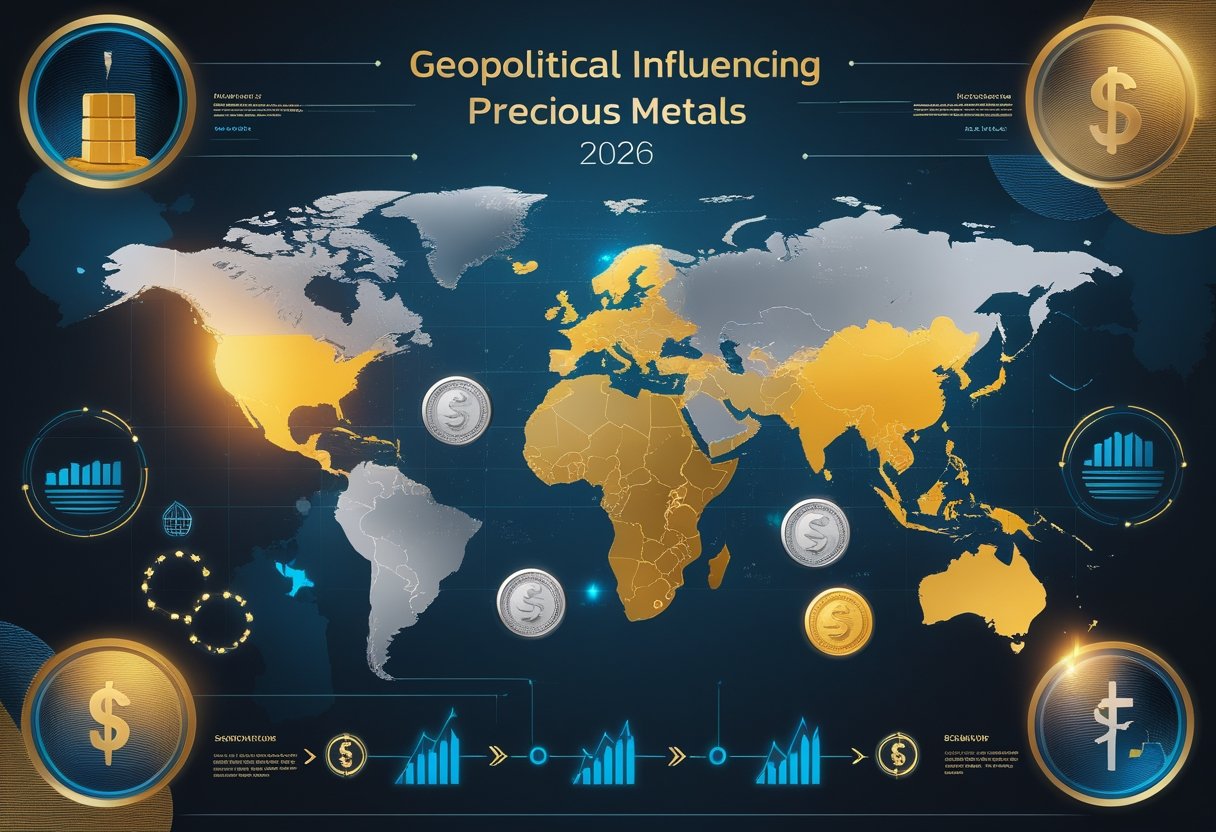
Geopolitical shifts change supply chains, central-bank behavior, and investor demand for safe assets. Expect trade rules, sanctions, and regional conflicts to directly affect availability and price volatility for gold, silver, and platinum.
Global Trade Policies
You should watch tariffs, export controls, and strategic stockpile policies because they alter metal flows and production costs. For example, import duties on refined metals raise domestic prices and encourage local hoarding, while export restrictions in major producers can tighten global supply quickly.
Central bank actions tied to trade tensions matter for price direction. If countries respond to trade disputes with currency interventions or reserve diversification, demand for gold as a non-sovereign reserve can rise. Also track free‑trade agreements and customs changes in metal‑processing hubs like China and the EU; those influence manufacturing demand for silver and platinum used in industry.
Regulatory moves on recycling and environmental standards affect supply elasticity. Stricter rules for mining and refining increase production costs and can push producers to limit output, tightening markets you rely on for physical metal availability.
Conflict Zones and Resource Access
You must monitor conflicts in regions that host mining or processing capacity because disruptions shift both near‑term supply and long‑term investment decisions. Conflicts in Africa, South America, or Central Asia can halt mine output, delay shipments, and raise insurance and transport costs for mined metals.
Control of key logistics nodes—ports, rail lines, and refineries—matters as much as the mine itself. If fighting or sanctions block a major refinery or concentrate export route, refined metal availability in global markets can drop even if nominal ore production remains unchanged.
Finally, geopolitical risk changes investor behavior. Heightened tensions tend to push you toward physical holdings and ETFs as safe havens, while prolonged instability prompts sovereign buyers to increase official reserves, amplifying price pressure for the metals you track.
Technological and Industrial Applications
Precious metals are seeing rising demand from energy, electronics, and medical industries that use specific properties—conductivity, corrosion resistance, and catalytic activity—to solve practical problems and meet regulatory standards.
Renewable Energy Sector Growth
You’ll find silver and platinum group metals integral to solar and hydrogen technologies.
Silver remains the most conductive metal used in photovoltaic cells; increased global solar installations require more silver per watt when manufacturers prioritize efficiency over cost. That directly affects physical demand and near-term fabrication schedules.
Platinum and palladium drive electrolyzers and fuel-cell systems.
As countries scale green-hydrogen projects, manufacturers need durable catalysts that withstand harsh operating conditions, supporting higher load factors and longer service intervals.
Key drivers you should watch:
- National decarbonization targets and auction cycles that trigger large solar or electrolyzer orders.
- Material-intensity trends: shifts toward higher-efficiency panels or different catalyst loadings change metal tons required per MW.
Electronics and Electric Vehicles
Your devices and EVs rely on gold, silver, and palladium for reliable conductivity and corrosion resistance.
Gold plates critical connector pins and bonding wires in smartphones and servers; even modest production growth in data centers and 5G infrastructure raises steady incremental demand.
In EVs, silver and copper-free electrical contacts, plus palladium in multilayer ceramic capacitors and sensors, matter to manufacturers.
Battery and power-electronics scaling increases demand for high-reliability contacts and cooling solutions that often incorporate precious-metal finishes.
Practical signals to monitor:
- EV production forecasts and announced gigafactory capacities.
- Component-level substitution: any move to reduce precious-metal content per unit will materially affect consumption trends.
Healthcare and Medical Device Uses
You encounter precious metals in diagnostics, implants, and precision instruments.
Silver’s antimicrobial coatings appear in wound care and surgical tools; its use reduces infection risk and extends product lifespans.
Gold and platinum serve as stable electrode materials in implantable devices and biosensors.
Their biocompatibility and resistance to corrosion make them preferred for pacemaker leads, neural interfaces, and lab-on-chip electrodes where signal fidelity matters.
Adoption factors that influence demand:
- Regulatory approvals and hospital procurement cycles that accelerate device rollouts.
- Advances in point-of-care diagnostics that increase single-use sensor volume, affecting short-cycle industrial demand.
Historical Performance and Future Projections
Precious metals have shown periods of sharp appreciation tied to inflation spikes, currency weakness, and central-bank buying. Analysts expect these drivers to continue influencing prices into 2026, with institutional flows and ETF demand likely to remain material factors.
Past Market Cycles
You can trace recent cycles to central-bank policy and macro shocks. For example, gold rallied strongly during high inflation and loose monetary conditions in the late 2010s–2020s, then surged past prior all-time highs after persistent monetary accommodation and geopolitical uncertainty.
Silver has historically amplified gold moves; it outperformed in 2025 amid supply constraints and stronger industrial demand.
Technical patterns matter too. Breakouts and follow-through phases in 2024–2025 established new trading ranges that set the stage for multi-year trends.
If historical relationships hold, sustained central-bank accumulation, real-rate compression, and robust ETF inflows tend to support higher nominal prices and greater volatility.
Analyst Forecasts for 2026
Major institutions and market strategists project above-trend demand in 2026. Several forecasts incorporate continued central-bank purchases and sizable ETF inflows—one estimate pegs potential ETF inflows near 250 tonnes for the year.
J.P. Morgan and other large research teams model scenarios where persistent reserve diversification pushes price targets materially higher by year-end 2026.
You should weigh differing assumptions: inflation paths, real rates, and dollar strength drive dispersion across models.
Assess probabilities rather than a single number; use ranges and stress-test your allocation for outcomes that include both stronger-than-expected institutional demand and short-term pullbacks.
Potential Risks and Market Challenges
You should expect sharper price swings and stronger competition for capital in 2026. Prepare for scenarios where policy shifts, industrial demand changes, or alternative assets reduce upside or increase downside risk.
Volatility and Price Fluctuations
Precious metals often respond fast to shifts in real interest rates, Fed guidance, and geopolitical shocks. If the Federal Reserve signals faster-than-expected rate cuts or bond yields move higher, gold and silver can drop quickly as the opportunity cost of holding non-yielding assets rises.
Supply-side events can also trigger volatility. Mining strikes, mine closures, or concentrated production changes in top silver or gold producers can tighten physical supply and spike prices short term. Conversely, unexpected mine ramp-ups, recycling surges, or large central bank sales can pressure prices downward.
Positioning risks matter. Leveraged ETF flows, large options expiries, or concentrated hedge fund positions can amplify moves and create rapid squeezes. Manage exposure sizes and use stop limits or staged purchases to reduce the impact of sudden reversals.
Alternative Investment Competition
You face growing competition from assets that can divert investor capital away from metals. Equity sectors tied to AI, renewable energy, and battery materials may offer higher expected returns in 2026 and attract portfolio allocations away from bullion and miners.
Fixed income dynamics matter too. If real yields recover because inflation cools faster than expected, Treasury yields become more attractive relative to gold, reducing metal demand from income-sensitive investors. Also consider crypto: renewed risk-on appetite or a regulatory clarity wave could pull speculative capital into Bitcoin and other digital assets.
Industrial substitution and technology risk may alter silver demand. Advances that reduce silver content in photovoltaics or electronics would lower a key source of physical demand. Track patent developments and manufacturer procurement data to assess this risk.
Conclusion
You should weigh multiple, converging drivers when considering precious metals for 2026. Central bank buying, continued industrial demand, and persistent macro risks create a favorable backdrop without guaranteeing short-term gains.
Allocate based on your time horizon and risk tolerance. Dollar-cost averaging or staged purchases can reduce timing risk while keeping you exposed to potential upside.
Expect volatility alongside structural support. Prices can spike or dip quickly; official-sector demand and low real yields tend to limit deep, sustained declines.
Keep position sizing disciplined and maintain liquidity for opportunities or unexpected needs. Use bullion, coins, or ETFs depending on storage, cost, and tax preferences.
Key practical steps:
- Review portfolio allocation and target weight for metals.
- Choose purchase cadence and vehicle (physical vs. paper).
- Monitor real yields, central bank action, and geopolitical developments.
If you prioritize long-term portfolio diversification and inflation protection, 2026 presents a compelling case to increase exposure. Stay practical, monitor the market drivers, and adjust your plan to fit your financial goals.