When you compare a troy ounce with a standard ounce of gold, the difference comes down to the measurement system. One troy ounce of gold weighs 31.1035 grams, while a standard ounce weighs 28.3495 grams.
Gold dealers, mints, and financial markets use troy ounces to price and sell most bullion products. Understanding the distinction helps you compare prices accurately, check product weights, and avoid confusing a regular ounce with the unit used for precious metals.
You will also see how gold products display their weights, how pricing conventions affect calculations, and how to convert between grams, standard ounces, and troy ounces without costly mistakes.
Weight Units Defined
When you compare gold prices or weights, you need to distinguish between the troy ounce used for precious metals and the standard ounce used for everyday goods. Their different gram values can affect pricing, product descriptions, and calculations.
What a Troy Ounce Measures
A troy ounce (ozt) measures the mass of gold, silver, platinum, and other precious metals. One troy ounce equals 31.1034768 grams, while a troy pound contains 12 troy ounces.
Gold markets typically quote prices per troy ounce. For example, a gold bar labeled “1 oz” usually contains one troy ounce of gold unless the seller specifies another unit. The label describes weight, not purity: a 1-troy-ounce bar marked 999.9 contains 99.99% pure gold, with the remaining fraction made up of other materials.
You can convert troy ounces to grams by multiplying the quantity by 31.1034768. A 2-ozt bar therefore weighs approximately 62.21 grams.
What a Standard Ounce Measures
A standard ounce, also called an avoirdupois ounce, measures many ordinary goods, including food, household products, and industrial materials. One standard ounce equals 28.349523125 grams.
This unit differs from the troy ounce by about 2.7549 grams, making a troy ounce approximately 9.7% heavier. If you mistake one unit for the other, you may underestimate the amount of gold represented by a quoted weight or miscalculate its value.
| Unit | Grams | Common use |
|---|---|---|
| Troy ounce | 31.1034768 g | Gold and other precious metals |
| Standard ounce | 28.349523125 g | Everyday commercial goods |
Always check whether a seller lists weight in ozt, grams, or standard ounces before comparing products.
Origins of the Troy Weight System
The troy system developed from medieval European trading practices and became associated with the French market town of Troyes, an important commercial center. Merchants used standardized weight units to trade valuable materials, including metals and gemstones.
The system continued because precious metals required consistent measurement across markets. Its structure differs from the everyday avoirdupois system: a troy pound contains 12 troy ounces, whereas a standard pound contains 16 standard ounces.
Modern bullion markets still use the troy ounce as their primary pricing unit. Although you may buy gold in grams or kilograms, dealers and financial markets commonly convert those amounts to troy ounces when quoting spot prices.
The Exact Weight Difference
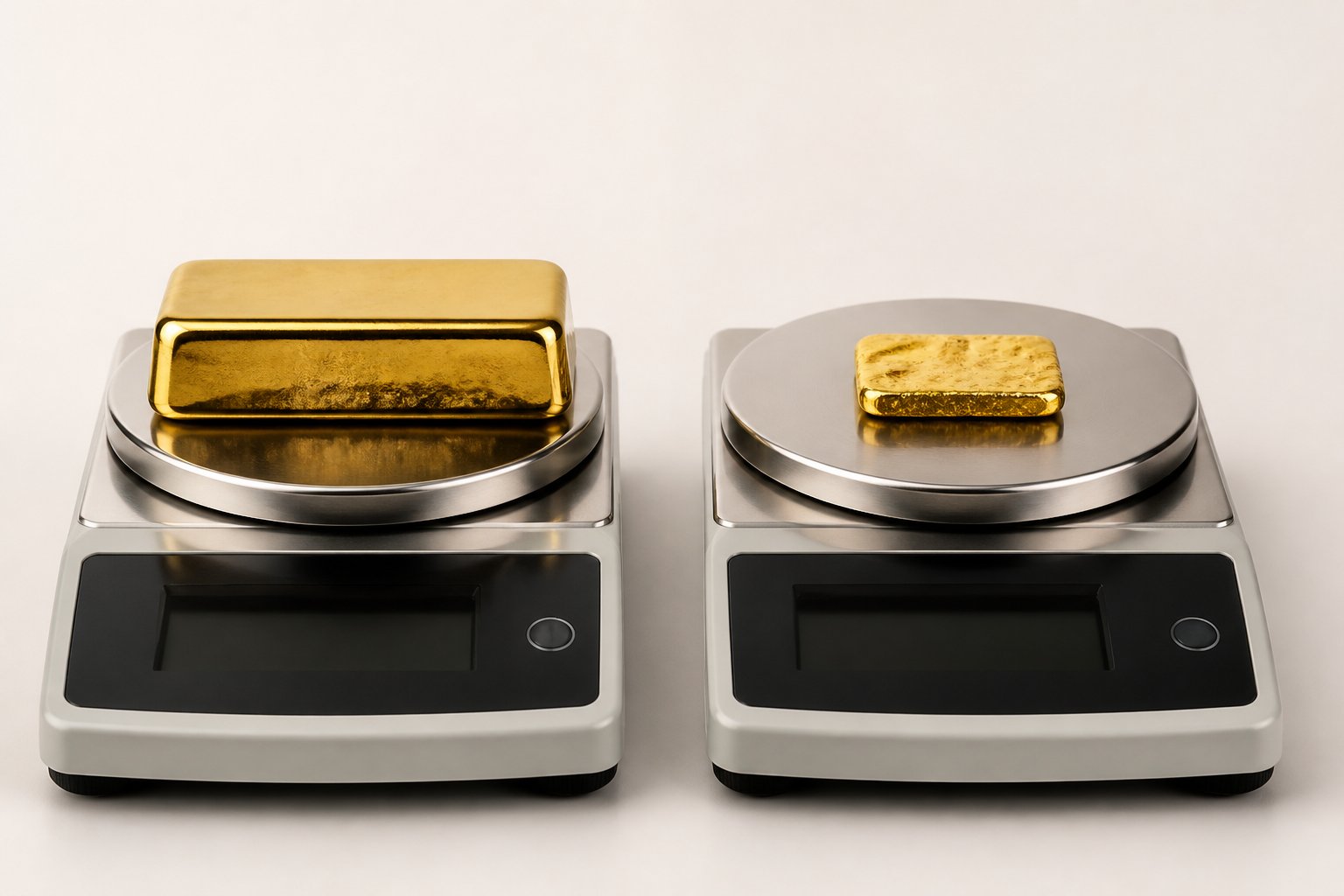
A troy ounce contains more gold by weight than a standard ounce. The difference affects conversions, quoted prices, coin specifications, and the value of your holdings.
Grams in Each Unit
One troy ounce equals exactly 31.1034768 grams. A standard ounce, also called an avoirdupois ounce, equals approximately 28.3495 grams.
| Unit | Weight in grams |
|---|---|
| 1 troy ounce | 31.1034768 g |
| 1 standard ounce | 28.3495 g |
| Difference | 2.7539768 g |
Gold dealers, refiners, mints, and financial markets use troy ounces to measure gold. If a gold bar contains one troy ounce of fine gold, it contains 31.1034768 grams of gold, not 28.3495 grams.
When a product lists its weight only as “one ounce,” check whether the seller means a troy ounce. Gold products normally use troy ounces, while household goods and many commercial products use standard ounces.
Percentage Difference Between Units
A troy ounce weighs about 9.7% more than a standard ounce. Put another way, one troy ounce equals approximately 1.097 standard ounces.
You can calculate the difference by subtracting the standard ounce from the troy ounce, then dividing by the standard-ounce weight:
(31.1034768 − 28.3495) ÷ 28.3495 × 100 ≈ 9.72%
This percentage matters when you compare weights expressed in different units. A seller offering 28.3495 grams of gold has supplied one standard ounce by weight, but only about 0.9115 troy ounce.
For accurate comparisons, convert every measurement to the same unit before calculating a price or assessing a purchase. Gold prices typically use the troy ounce as the reference unit.
Why the Distinction Matters
The distinction directly affects how you evaluate gold’s price and quantity. If gold sells for a quoted amount per troy ounce, multiplying that price by a standard ounce produces an incorrect result because the standard ounce contains less gold.
Suppose gold is priced at $2,000 per troy ounce. One standard ounce contains 28.3495 grams, or approximately 0.9115 troy ounce, so its metal value at that rate would be about $1,823, before premiums, fees, or other costs.
Check product labels, invoices, and dealer listings for terms such as troy oz, ozt, or 31.1 g. Also confirm whether a listed weight describes the total item or the amount of fine gold, since purity determines how much actual gold the product contains.
Gold Pricing and Market Conventions
Gold prices normally use the troy ounce, while many everyday products use the lighter avoirdupois ounce. You need to distinguish the quoted spot price from the final price of a bar or coin, then apply the correct weight and purity when comparing products.
How Spot Gold Is Quoted
The gold spot price represents the current wholesale-market value of one troy ounce of gold, usually quoted in U.S. dollars per troy ounce. One troy ounce equals 31.1035 grams, whereas a standard avoirdupois ounce equals 28.3495 grams.
Spot prices change throughout global trading hours as currency values, interest-rate expectations, investment demand, economic data, and geopolitical developments affect buying and selling. A quoted spot price generally refers to highly pure gold, commonly .999 fine, rather than a specific coin or bar.
You should treat spot gold as a benchmark, not the guaranteed checkout price. Dealers add premiums for fabrication, transportation, refining, inventory, distribution, and profit. Retail prices can also include taxes, shipping, payment fees, and market-specific charges.
Bullion Product Weight Labels
Bullion labels typically state weight in troy ounces, grams, or kilograms. A product marked “1 oz gold” normally means one troy ounce, containing 31.1035 grams of gold by total weight when the item has the stated purity.
| Label | Approximate metric weight |
|---|---|
| 1 troy oz | 31.1035 g |
| ½ troy oz | 15.5517 g |
| ¼ troy oz | 7.7759 g |
| 1 gram | 0.03215 troy oz |
Check both the weight and fineness. A 1 troy ounce coin marked .999 fine contains about 31.072 grams of pure gold, while a 22-karat coin may weigh one troy ounce but contain less pure gold because it includes alloy metals.
Do not compare a product labeled only “one ounce” without confirming the measurement system. Jewelry and non-bullion goods may use ordinary ounces, grams, or karats instead.
Price Calculations by Weight
To estimate a product’s metal value, multiply the spot price per troy ounce by the product’s pure-gold content:
Melt value = spot price × weight in troy ounces × purity
For example, a 1 troy ounce item with .999 purity contains 0.999 troy ounces of pure gold. If the spot price is $2,500 per troy ounce, its estimated metal value is:
$2,500 × 1 × 0.999 = $2,497.50
For gram-based products, divide the troy-ounce spot price by 31.1035 to calculate the approximate price per gram. A dealer’s selling price will usually exceed this calculation because of the retail premium, while a buyback offer may fall below it. Compare products using pure-gold content and the total delivered price, not the label alone.
Gold Products Commonly Measured in Troy Ounces
Gold bars, coins, jewelry, and scrap are commonly priced by their fine-gold content in troy ounces. You should distinguish that unit from the regular avoirdupois ounce, especially when comparing weights, prices, premiums, or resale offers.
Investment Bars
Refiners and mints commonly sell gold bars in sizes such as 1 gram, 10 grams, 1 troy ounce, 100 grams, and 1 kilogram. A 1-troy-ounce bar contains 31.1035 grams of total weight when it has 99.9% or greater purity; its fine-gold content depends on the stated fineness.
Check the bar’s weight, purity, and hallmark before buying. A mark such as 999 or 999.9 indicates the approximate percentage of gold, while an assay card may verify those details. Larger bars often carry lower premiums per troy ounce, but smaller bars can offer greater flexibility when you sell part of your holdings.
Gold Coins
Many bullion coins use a 1-troy-ounce size, including widely traded coins from national mints. A coin described as containing one troy ounce of gold may weigh slightly more than 31.1035 grams because its alloy includes small amounts of silver, copper, or other metals.
Read the coin’s specifications carefully. Some coins contain one troy ounce of pure gold, while fractional coins contain ½, ¼, or ¹⁄₁₀ troy ounce. Collectible or proof coins can sell for more than their metal value because condition, rarity, design, and demand affect the premium.
Jewelry and Scrap Gold
Jewelry is usually priced according to its karat purity, not simply its total weight. For example, 18-karat gold contains 75% gold, so a 31.1035-gram piece contains less than one troy ounce of pure gold after accounting for its alloy.
When you sell scrap, a dealer typically weighs the item, tests its purity, and calculates its approximate fine-gold content. Stones, clasps, solder, and other non-gold materials reduce the payable amount. Compare the dealer’s offer with the current gold price per troy ounce, and ask whether the quoted price reflects the full melt value or a deduction for refining and handling.
Avoiding Common Buying and Selling Errors
Check every weight, price, purity mark, and fee before you commit to a transaction. Using troy ounces consistently and separating metal content from product weight helps you compare offers accurately.
Checking Product Specifications
Confirm whether the listed weight uses troy ounces (ozt) or regular avoirdupois ounces. One troy ounce equals 31.1035 grams, while one regular ounce equals 28.3495 grams. Gold, silver, platinum, and palladium prices normally use troy ounces.
Read the product description for its exact form and weight. A “1-ounce gold coin” generally means one troy ounce of total fine gold, but some coins contain less than one troy ounce and carry fractional labels such as ½ oz or ¼ oz. Check the stated weight in grams, the fineness, and the manufacturer or mint.
When selling, photograph or record the specifications before shipping. Keep the assay card, receipt, and original packaging when available, because dealers may need them to verify authenticity and condition.
Comparing Dealer Prices
Compare the total purchase price, not just the advertised price per ounce. Include shipping, insurance, payment surcharges, taxes, and any fabrication or dealer premium. A lower quoted price can cost more after these additions.
When selling, ask for the dealer’s buyback price and confirm whether it applies to your specific product. Dealers may quote different prices for bars, sovereign coins, collectible coins, and damaged items. Compare offers using the same unit:
| Amount | Equivalent weight |
|---|---|
| 1 troy ounce | 31.1035 grams |
| 1 regular ounce | 28.3495 grams |
If a dealer quotes a price per gram, multiply it by 31.1035 to compare it with a troy-ounce price. Avoid comparing a troy-ounce quote with a regular-ounce quote without converting the units first.
Understanding Purity and Fine Gold Content
A gold item’s gross weight does not always equal its gold weight. Purity, expressed as fineness, shows the proportion of pure gold: 24-karat gold is approximately 99.9% pure, while 22-karat gold is approximately 91.7% pure.
Calculate fine-gold content by multiplying the item’s weight by its purity. For example, a 1-troy-ounce coin that is 91.7% pure contains about 0.917 troy ounces of fine gold. A 10-gram bar marked .999 contains about 9.99 grams of fine gold.
Check the hallmark, fineness stamp, and independent assay information. Do not treat gold-plated, filled, or vermeil items as solid gold, and ask the buyer how testing affects the final offer before you sell.
Converting Gold Weights Accurately
Gold markets quote weight in troy ounces, while everyday measurements usually use standard avoirdupois ounces. Use the correct unit before comparing prices, checking a dealer’s offer, or calculating the value of jewelry and bullion.
Troy Ounces to Grams
One troy ounce (ozt) equals exactly 31.1034768 grams, commonly rounded to 31.1035 grams. To convert a gold weight from troy ounces to grams, multiply the number of troy ounces by 31.1035.
Formula:
grams = troy ounces × 31.1035
For example, 2 ozt of gold weighs approximately 62.207 grams. To convert grams back to troy ounces, divide by 31.1035:
troy ounces = grams ÷ 31.1035
A 10-gram gold bar therefore contains about 0.3215 ozt. Check whether a product lists its weight in grams or troy ounces, because confusing the two units can produce a significant valuation error.
Standard Ounces to Troy Ounces
A standard ounce, also called an avoirdupois ounce, equals 28.3495 grams. It is lighter than a troy ounce, which contains 31.1035 grams. One standard ounce equals approximately 0.9115 troy ounces.
Formula:
troy ounces = standard ounces × 0.9115
For example, 5 standard ounces equal about 4.5575 troy ounces. To convert in the other direction, multiply troy ounces by approximately 1.0971 to find standard ounces.
Do not use a standard-ounce conversion when a gold price is quoted per troy ounce. If a seller describes a gold item using ordinary ounces, convert its weight to troy ounces before multiplying by the market price.
Using Conversion Tools
A conversion calculator can reduce arithmetic errors, especially when you compare grams, troy ounces, kilograms, or pennyweights. Enter the unit shown on the scale, product listing, or assay certificate, then select troy ounces (ozt) as the output when you need to compare the weight with a gold price.
Check the calculator’s labels carefully. Some tools use “oz” for standard ounces and “ozt” for troy ounces, while others display both as ounces. Use these reference values to verify the result:
| Measurement | Equivalent |
|---|---|
| 1 ozt | 31.1035 g |
| 1 standard oz | 28.3495 g |
| 1 ozt | 1.0971 standard oz |
A calculator converts weight, not purity or value. For an accurate price estimate, you must also account for the gold’s fineness and the applicable buying or selling premium.