You face a market where small shifts in supply, industrial demand, monetary policy, and investor flows can swing silver prices sharply. Silver’s volatility stems mainly from its dual role as both an industrial metal and a precious metal, combined with a relatively small, thinly traded market that amplifies speculative flows.

This post will break down those fundamental forces alongside macroeconomic shifts, investment and speculative activity, geopolitical events, currency moves, regulatory changes, industrial innovation, seasonal patterns, and sudden economic shocks so you can see how each factor pushes prices up or down. Follow along to learn which forces matter most to your position and how to spot the signals before they move the market.
Fundamental Market Forces
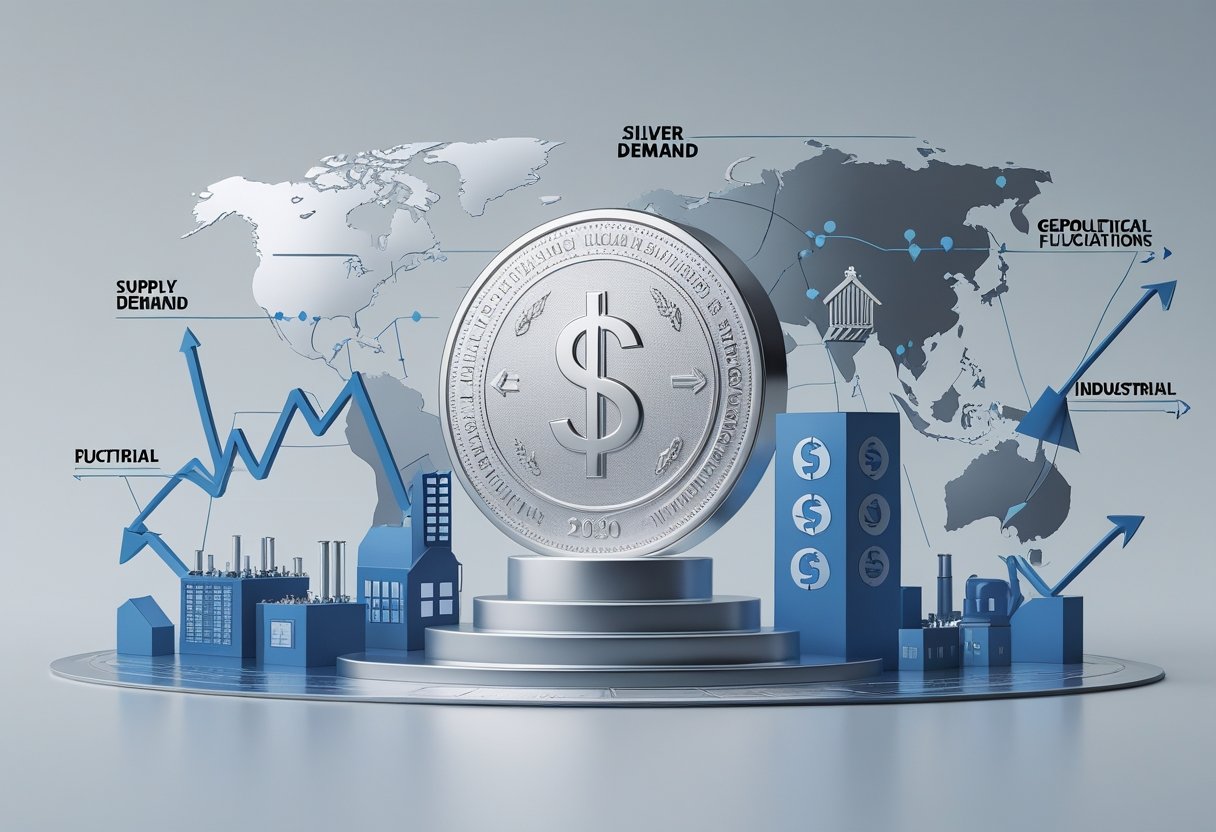
You will see how shifts in supply, mine production, and industrial demand directly move silver prices. Each factor can cause rapid price changes when it shifts unexpectedly or interacts with the others.
Supply and Demand Imbalances
Imbalances occur when physical silver supply—mined output plus secondary sources like recycling—doesn’t match bar, coin, and industrial demand. Small changes in either side can produce outsized price moves because silver’s market is relatively small compared with major commodities.
Key drivers of imbalance:
- Inventory swings: ETF holdings and exchange warehouses change quickly and alter available metal for traders.
- Recycling variability: Recycled silver flows depend on industrial scrap and consumer behavior, which can drop sharply in tight markets.
- Hoarding and de-hedging: Rapid accumulation by investors or de-hedging by producers removes metal from circulation and tightens supply.
You should watch inventory reports, ETF flows, and reported physical deliveries. Those data points reveal tightening or easing that often precedes volatile price shifts.
Silver Mining Output
Mine production supplies roughly 60–70% of annual silver, but output growth is slow and concentrated in a few countries. Because adding or reducing large-scale mining capacity takes years, production responds poorly to short-term price moves.
Production risk factors:
- Geographic concentration: Major producers like Mexico, Peru, and China account for a large share of output; disruptions there—strikes, permitting delays, or weather—translate quickly into supply shocks.
- By-product dynamics: Much silver is produced as a by-product of copper, lead, and zinc mining. Changes in base-metal prices can reduce or raise silver output independently of silver demand.
- Capital and time lag: New mines and expansions require multi-year investment and permitting, so supply cannot quickly expand to meet sudden demand spikes.
Track quarterly mine reports and by-product ratios to anticipate near-term supply tightness or loosening.
Industrial Usage Trends
Industrial demand accounts for a significant portion of silver consumption, with photovoltaics, electronics, and chemical processes among the largest uses. Technological and policy shifts in these sectors alter structural demand over time.
Specific influences:
- Solar PV adoption: Utility-scale and rooftop solar use silver paste for PV cells. Faster solar deployment raises demand; improvements in cell design can reduce silver intensity per module.
- Electronics and 5G: Conductive and antimicrobial properties keep silver important in connectors, switches, and sensors. Growth in electronics increases steady industrial consumption.
- Substitution and efficiency: Manufacturers may substitute or reduce silver content during price spikes, which can temper long-term demand growth but often lags behind rapid price moves.
You should monitor solar installation forecasts, electronics production cycles, and announcements of silver-reducing technologies to gauge upcoming demand pressure.
Macroeconomic Influences

Macroeconomic forces drive large-scale shifts in silver demand and the relative attractiveness of holding bullion or futures. Expect sharp price moves when economic indicators, policy changes, or global crises alter investor and industrial behavior.
Global Economic Uncertainty
When global growth slows or recession risks rise, you often see a flight to perceived safe assets. Silver benefits sometimes because investors treat precious metals as stores of value, but its industrial demand can weaken simultaneously, creating mixed price signals.
Geopolitical shocks, trade disruptions, or banking-sector stress raise volatility quickly. Prices can spike as investors buy physical metal and futures, then reverse if industrial orders fall or liquidity squeezes force selling.
Monitor PMI, trade volumes, and major central bank statements; they move silver prices within hours to weeks.
Inflation and Deflation Impacts
Rising consumer prices increase demand for tangible assets that preserve purchasing power. You may buy silver when real yields turn negative or when inflation expectations climb, pushing prices higher over weeks to months.
Deflationary episodes cut industrial activity and reduce demand for silver used in electronics and solar, pressuring prices downward. Short-term technical selling often follows rapid drops in inflation expectations, so keep an eye on CPI releases, breakeven inflation rates, and commodity-side demand indicators.
Interest Rate Fluctuations
Interest rates determine the opportunity cost of holding non-yielding silver. When central banks raise rates, you may prefer bonds or cash, which can draw money away from silver and depress prices.
Conversely, falling rates lower real yields and increase the appeal of precious metals. Rate volatility itself amplifies trading in futures and options, increasing short-term price swings. Track policy guidance, rate decision calendars, and real yields to anticipate directional pressure on silver.
Investment and Speculative Activity
Institutional flows, retail trades, and ETF rebalancing can push silver prices sharply in short windows. You will see volatility when concentrated positions change, speculative leverage increases, or physical buying outpaces available supply.
Institutional Investor Behavior
Large funds and commodity trading desks move sizable volumes that can swing prices quickly. When hedge funds add leveraged long positions in silver futures, your market sees amplified moves because the COMEX and OTC markets have limited depth relative to typical institutional order sizes.
Institutions also use derivatives to hedge exposures in electronics, photovoltaics, and mining. Those hedges can create transient selling pressure; when firms unwind hedges, you may observe sudden price rebounds. Regulatory changes or margin adjustments at major clearinghouses can force position changes, producing outsized short-term volatility you can track by monitoring open interest and large trader reports.
Retail Trading and Physical Demand
Retail traders often enter silver through small, frequent trades using margin or options, which raises intraday volatility. You can detect retail-driven spikes around social media-driven buying frenzies or macro headlines that prompt high-turnover activity in futures and CFDs.
Physical demand from industrial users and coin/bullion buyers exerts a steadier influence. When fabrication demand rises—especially in electronics and solar—or when coin sales surge after price drops, physical buying can outstrip available dealer inventories. That imbalance forces dealers to pay premiums or draw from futures markets, feeding further price movement you can observe in bid-ask spreads and premium levels.
Exchange-Traded Funds (ETFs) Movements
ETFs create a bridge between paper and physical silver, and their flows matter to price discovery. When large inflows occur, ETF managers convert cash into allocated silver or long futures, increasing physical withdrawals from vaults or adding futures open interest; you will see price support during sustained inflows.
Conversely, rapid outflows force ETF issuers to sell silver or unwind futures, which can accelerate downward moves. Watch creation/redemption data and ETF inventory levels; sudden divergences between ETF holdings and spot liquidity often precede heightened volatility.
Geopolitical Events

Geopolitical shocks change supply routes, investor behavior, and policy expectations that directly affect silver’s price and liquidity. You should watch state actions and international disputes because they often trigger rapid buying or selling in physical and futures markets.
Political Instability
When a major silver-producing country faces unrest, mining output and export flows can fall quickly. For example, strikes, regulatory seizures, or armed conflict in Peru or Mexico can reduce concentrate shipments for months, tightening physical availability and pushing premiums higher.
You also see elevated speculative flows during instability. Traders move into or out of silver futures and ETFs based on perceived risk, which amplifies short-term price swings even if actual mine supply changes slowly.
Central banks and governments may impose emergency measures—capital controls, export bans, or forced nationalization—that alter cross-border metal movements. Those policy shifts reduce market liquidity and increase bid-ask spreads, making prices more volatile for you as a buyer or seller.
Trade Policies and Tariffs
Tariffs and export controls immediately affect trade economics for silver and silver-containing products. If a major processor faces a new tariff, your supply chain costs rise and dealers may hoard refined silver, creating localized shortages and price spikes.
Export licensing or quotas, like recent rules requiring approval for outbound silver shipments, can fragment global flows. Fragmentation reduces arbitrage efficiency between regional markets, allowing prices to diverge and volatility to persist.
You should monitor announced trade measures and effective dates closely. Markets often move on anticipation and rushed repositioning by industrial consumers, jewelers, and investors, producing price swings before any physical impact is measurable.
Currency Movements
Currency shifts often move silver prices because traders price silver in dollars and because industrial demand and imports change with exchange rates. You should watch the dollar and FX volatility closely: they can amplify silver moves through both investment flows and trade-cost adjustments.
U.S. Dollar Strength
A stronger U.S. dollar typically lowers silver’s dollar price because each dollar buys fewer ounces for holders of other currencies. When the dollar rallies, non-dollar investors need more local currency to buy the same physical or paper silver, reducing foreign demand and pressuring prices.
Dollar strength also raises opportunity cost for investors seeking safety in precious metals. Higher real yields tied to a firm dollar make dollar cash and Treasuries more attractive versus non-yielding silver, which can trigger selling in speculative positions and futures.
Watch these indicators for actionable signals:
- DXY index moves and trend changes.
- U.S. real yields (nominal yields minus inflation expectations).
- Fed policy shifts and rate-path guidance.
Foreign Exchange Market Volatility
Large swings across major currencies change cross-border silver flows and hedging costs, creating short-term price spikes. When the euro, yuan, or rupee moves rapidly, importers and jewelers adjust purchasing timing and volumes, affecting physical demand in those regions.
FX volatility also impacts leveraged speculative trading. Rapid currency swings widen margins and can force liquidation of futures and ETF positions denominated in dollars or local currencies, which magnifies silver’s intra-day moves.
Key dynamics to monitor:
- Volatility indices for major pairs (EUR/USD, USD/CNY, USD/INR).
- Central bank interventions or capital controls that alter local buying power.
- Cross-border trade balances in silver-consuming countries like India and China.
Regulatory and Market Structure Changes
Regulatory shifts and the mechanics of trading venues can change where and how silver is priced, stored, and moved. These factors directly affect liquidity, delivery certainty, and the ability of large players to influence short-term price swings.
Commodity Exchange Regulations
Exchange rules determine contract specifications, delivery locations, and margin requirements that you rely on when trading silver futures and options. Tightening margins raises the cash needed to hold positions, which can force leveraged traders to liquidate quickly and widen intraday moves. Changes to delivery rules — such as approved vault lists or allowed form (bars vs. coins) — alter physical flows and inventory concentrations in key hubs like COMEX or LBMA vaults.
Regulators also impose reporting and position limits. When position-reporting thresholds fall or enforcement tightens, you may see reduced anonymity for large traders and smaller, choppier markets as participants reduce size. Finally, new cross-border trade controls or export approvals can reroute supply, and that rerouting shows up as price gaps when markets adjust.
Market Manipulation Cases
Historical manipulation allegations show how concentrated positions and weak oversight can magnify volatility that affects your trades and holdings. Cases have involved spoofing, wash trades, and large concentrated buys or sells timed to exploit margin rules or settlement procedures. When regulators investigate or levy fines, you often see abrupt price moves as participants reassess counterparty risk and position exposure.
Remedies like stronger surveillance, higher penalties, and mandatory electronic audit trails reduce some abusive behavior, but enforcement lags can leave temporary windows for distortion. You should watch regulatory filings and enforcement actions closely; they provide clues about market integrity and the likelihood of outsized, manipulation-driven price swings.
Technological and Industrial Innovations
New manufacturing uses and better recycling routes are reshaping demand and supply for silver, driving price swings through real costs and tight physical availability.
Emerging Industrial Applications
You’ll find rising silver demand in solar photovoltaic cells, 5G and data center equipment, and electric vehicle electronics.
Silver’s superior conductivity and solderability make it essential for photovoltaic silver paste, contact ribbons, and high-reliability connectors. When large solar-build programs or EV incentives launch, fabrication yards increase purchases quickly, tightening physical markets.
Semiconductor and 5G component producers also boost short-run demand for ultra-fine silver inks and plated contacts. These industries can shift procurement on quarterly timescales, so production scaling or a factory outage can create rapid price impacts.
Institutional buyers and manufacturers often hedge differently than investors, so industrial-driven demand can produce volatility that doesn’t correlate with precious‑metal sentiment.
Recycling Advances
You can recover substantial amounts of silver from end-of-life electronics, photographic waste, and industrial scrap.
Improved hydrometallurgical and electrochemical extraction techniques increase recovery rates while lowering per-unit recycling costs, which can soften supply shocks when implemented at scale.
However, recycling supply lags behind new industrial demand because collection systems and cross-border waste flows are uneven. A breakthrough plant or policy change that raises recovered silver volumes quickly can dampen price spikes, whereas delays or stricter export rules can tighten the market and push prices higher.
Watch metrics such as recovery efficiency, number of large-scale recyclers online, and regional e‑waste flows; these indicate how much recycled metal can realistically offset primary demand.
Seasonal and Historical Volatility Patterns
You should expect silver to show recurring seasonal tendencies that can inform timing and risk management. Demand from industry, coin and bar buying, and agricultural cycles often push prices higher in certain months and lower in others.
Historical episodes highlight how abrupt swings can be. Events like speculative runs, regulatory shocks, or macroeconomic shocks have produced multi-year highs and rapid collapses that reshape trader expectations.
Use seasonality charts and historical high/low ranges to quantify risk before you trade. Common measures include annual high-low spreads and rolling volatility; these give you a sense of how large moves have been in past years.
Key seasonal patterns to watch:
- Early-year strength: Increased investment demand and repositioning can lift prices in Q1.
- Summer dips: Lower industrial activity and seasonal liquidity sometimes reduce upward pressure.
- Year-end rebounds: Portfolio rebalancing and holiday demand can spark rallies.
Quick reference table (typical, not guaranteed):
| Period | Typical behavior | Why it matters |
|---|---|---|
| Q1 | Often bullish | Investor inflows, new-year positioning |
| Q2–Q3 | Mixed/soft | Industrial slowdowns, lower liquidity |
| Q4 | Often rebound | Rebalancing, increased physical demand |
Pair seasonal signals with macro and technical analysis. That combination helps you avoid relying on seasonality alone and prepares you for sudden historical-style shocks.
External Economic Shocks
External economic shocks can shift silver prices quickly by changing investor risk appetites and real-world demand. When major economies slow or enter recession, industrial consumption for electronics and solar panels often falls, reducing one of silver’s key demand pillars.
You feel volatility when monetary policy surprises occur. Sudden interest-rate hikes or unexpected easing can move the U.S. dollar and inflation expectations, which in turn affect silver’s appeal as a store of value versus a commodity.
Geopolitical events create abrupt re-pricing across markets. Wars, trade embargoes, or sanctions can disrupt supply chains for mined silver and industrial inputs, producing immediate price swings as markets re-assess scarcity and production risk.
Market liquidity can evaporate during shocks, amplifying moves. If trading desks withdraw, even modest sell-offs or buying waves can produce outsized price changes because fewer counterparties absorb large orders.
Key mechanisms at a glance:
- Demand shock: Industrial slowdown lowers consumption.
- Monetary shock: Rate moves and dollar swings alter investment demand.
- Supply shock: Mine disruptions or trade barriers tighten availability.
- Liquidity shock: Reduced market depth magnifies price moves.
You should watch economic calendars and geopolitical headlines to anticipate potential shocks. Quick changes in expectations often determine the magnitude and direction of silver volatility.