You watch gold prices because they affect the value of your savings and investments, and the dollar’s strength often drives those moves. When the dollar strengthens, gold priced in dollars usually becomes more expensive for holders of other currencies, cutting global demand and putting downward pressure on gold; when the dollar weakens, gold often gains as buyers across the world find it cheaper and as investors seek inflation protection. A stronger dollar tends to push gold prices down, while a weaker dollar tends to lift them, though interest rates, inflation expectations, and global risk sentiment also shape the outcome.

This article will explain how the dollar’s role as the world’s primary reserve currency links to gold, show when the inverse relationship holds or breaks, and help you judge whether dollar moves matter more for short-term trading or long-term hedging decisions.
Understanding the Dollar’s Strength

You’ll learn how the dollar’s value is measured, which economic and market forces move the dollar index, and how other major currencies interact with the U.S. dollar. These elements determine how a stronger or weaker dollar affects gold prices and global trade.
How Currency Value Is Measured
Currency value is most commonly measured by exchange rates and the trade-weighted dollar index. The trade-weighted dollar index averages the dollar’s exchange rates against a basket of currencies, weighted by trade volume, so it reflects your real trading exposure. Spot exchange rates show how many units of a foreign currency one dollar buys at a given moment, which matters when you price goods or bullion across borders.
Real effective exchange rates adjust for inflation differences between the U.S. and trading partners. Market indicators such as forward rates and interest rate differentials also signal expected changes in value, which investors use for hedging and pricing assets like gold.
Factors Influencing the Dollar Index
Interest rate differentials are a primary driver: higher U.S. interest rates tend to attract capital into dollar-denominated assets, pushing the index up. Economic data—GDP growth, employment reports, and inflation readings—move expectations for Federal Reserve policy and thus the dollar’s direction.
Fiscal policy and public debt levels influence confidence in the dollar over the medium term. Safe-haven flows during geopolitical risk can strengthen the dollar temporarily, even if fundamentals are weak. Central bank interventions, foreign exchange reserves shifts, and large-scale trade imbalances also create measurable impacts on the index.
Relationship Between Major Currencies and the U.S. Dollar
Major pairs—EUR/USD, USD/JPY, GBP/USD, USD/CNY—dominate the dollar’s market behavior because of high trading volumes and economic linkage. For example, EUR/USD movements often drive the overall dollar index since the euro typically carries a large weight in trade-weighted baskets.
Currency peg policies, like those historically used by some emerging markets, and China’s managed float influence bilateral rates and create spillover effects for the dollar. Carry trades and capital flows into or out of yen or euro assets shift demand for dollars. You’ll see these dynamics transmit to commodity pricing, including gold, because bullion is priced in dollars and responds to cross-currency valuation changes.
Gold as an Investment Asset
Gold serves both as a store of value and a portfolio diversifier, influenced by interest rates, currency moves, and central bank actions. You should expect gold to react when the dollar, real yields, or geopolitical risk change.
Role of Gold in Global Portfolios
You use gold mainly to reduce portfolio volatility and protect purchasing power during inflationary or crisis periods. Many institutional portfolios allocate a modest percentage—commonly 2–10%—to gold or gold-related assets to improve risk-adjusted returns.
Physical bullion, ETFs, mining stocks, and futures each deliver different exposures and costs. Physical gold avoids counterparty risk but has storage and insurance expenses. ETFs provide liquidity and low transaction costs but carry issuer and operational risks. Mining equities add leverage to gold’s price but introduce company-specific and operational risks.
Central banks also hold gold as a reserve asset. Their buying and selling can shift supply–demand dynamics and influence price trends that directly affect your investment outcomes.
Historical Value of Gold
You should view gold’s long-term role as a monetary anchor and crisis hedge. Over decades, gold has preserved real value when currencies depreciated or when inflation spiked, though it does not produce income like bonds or dividends.
Price behavior varies by period: gold outperformed during the 1970s inflation surge and again in the 2000s–2010s amid quantitative easing and low real yields. It underperformed during strong economic expansions and rising real interest rates. Those cycles show that timing, macro context, and your horizon matter more than assuming steady appreciation.
Consider volatility: gold can move sharply in short windows, so position size matters. Use historical drawdowns to set stop-losses or allocation limits that match your risk tolerance.
Gold Pricing Mechanics
Gold’s price is set in global over-the-counter markets and major exchanges (LBMA, COMEX), quoted in US dollars per troy ounce. Because most contracts and spot quotes use dollars, currency moves directly affect local-currency prices you pay.
Key drivers you must monitor:
- US dollar strength: A stronger dollar typically lowers dollar-denominated gold prices; a weaker dollar tends to raise them.
- Real interest rates: Higher real yields increase the opportunity cost of holding non-yielding gold, pressuring prices.
- Central bank activity: Purchases or sales by sovereigns change demand materially.
- Physical demand: Jewelry and industrial uses add baseline consumption, while ETF flows and private investment create price swings.
You can track intraday liquidity and term structure (contango/backwardation) in futures to assess market tightness and near-term price pressures.
Direct Impact of Dollar Strength on Gold Prices
Stronger or weaker dollars change gold prices through price mechanics, international buying power, and investor behavior. Expect shifts in demand from central banks, traders, and consumers when the dollar moves significantly.
Inverse Correlation Explained
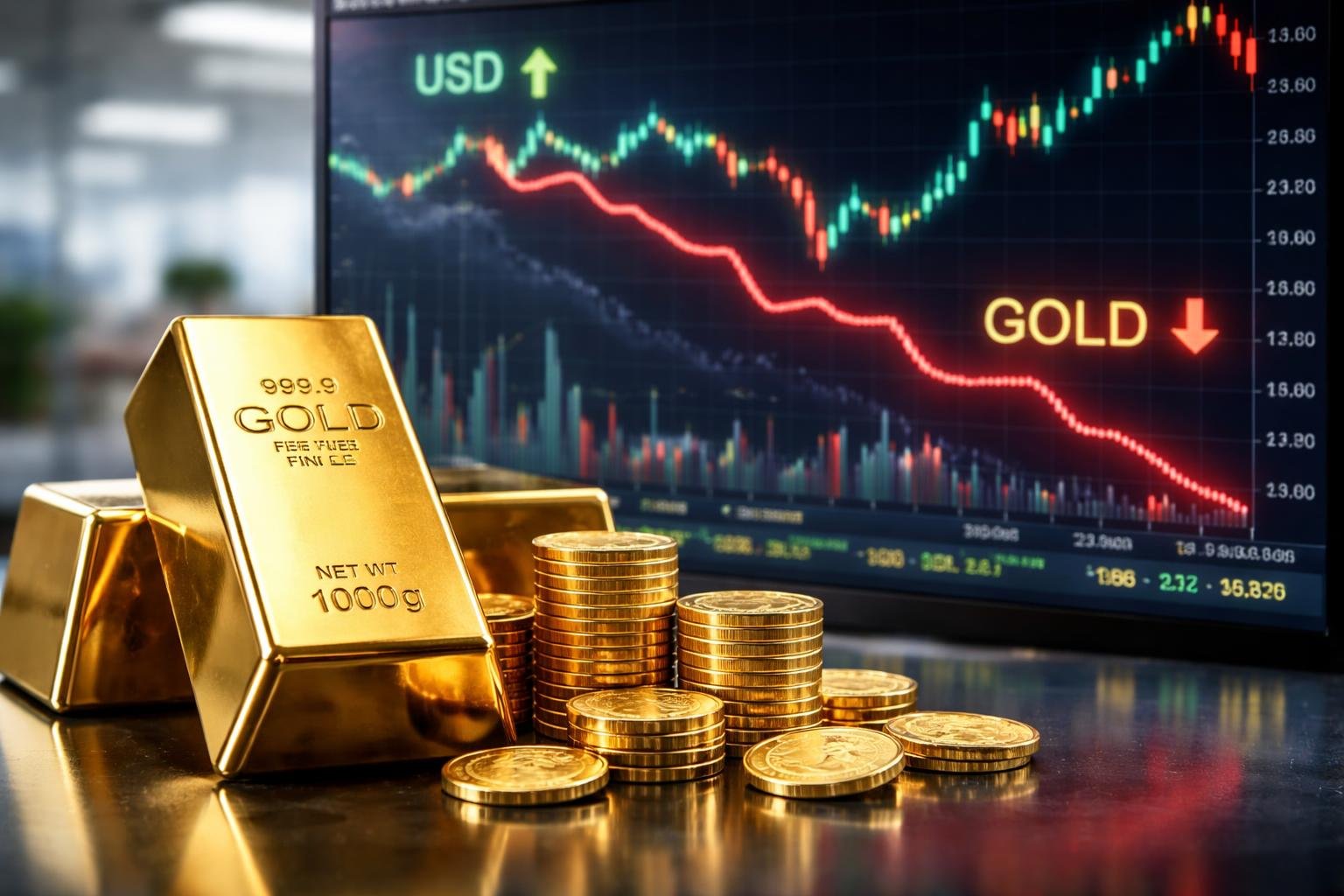
You often see gold and the U.S. dollar move in opposite directions. When the dollar strengthens, gold typically becomes more expensive for holders of other currencies, which tends to reduce foreign buying and puts downward pressure on dollar-denominated gold prices.
Conversely, a weaker dollar makes gold cheaper abroad, boosting international demand and pushing prices higher in dollar terms.
This inverse relationship is not perfect. Interest rates, inflation expectations, and geopolitical shocks can override the correlation. For example, higher U.S. real yields usually strengthen the dollar and reduce gold’s appeal because gold pays no yield. Still, the inverse link remains a useful starting point when you analyze gold price moves.
Gold Pricing in U.S. Dollars
Gold is globally quoted in U.S. dollars, so every change in the dollar directly alters the visible price you see on exchanges. A 1% rise in the dollar index generally produces a measurable decline in dollar-denominated gold, because overseas buyers need more of their local currency to purchase the same amount of gold.
This pricing convention also means dollar liquidity and FX market flows matter to gold traders.
When the Federal Reserve tightens policy, the dollar often gains and gold can fall even if inflation expectations rise. You should track U.S. monetary policy and the dollar index (DXY) to understand short- and medium-term movements in gold prices.
Effects on Gold Demand
Dollar strength reshapes demand across three key buyer groups: investors, central banks, and consumers. Investors may shift from gold into dollar assets when the dollar and real yields rise, reducing ETF flows and futures positioning.
Central banks diversify reserves irrespective of short-term swings, but sustained dollar weakness can accelerate official gold purchases as a hedge.
On the consumer side, jewelry and retail demand in countries with weakening local currencies usually increases, lifting global physical demand. Monitor cross-border demand patterns and ETF flows to gauge how dollar moves are translating into actual buying or selling pressure.
Economic and Market Factors Influencing Both Assets
Inflation, interest-rate moves, central bank policy, and geopolitical shocks drive both the dollar and gold. You should watch how these forces interact because they often push the dollar and gold in opposite directions, but not always.
Role of Inflation and Interest Rates
Rising inflation typically increases demand for gold as an inflation hedge, since gold preserves purchasing power when real yields fall. When inflation outpaces nominal yields, real interest rates turn negative; that environment makes non-yielding gold more attractive relative to cash and bonds.
Higher nominal interest rates tend to strengthen the dollar by attracting foreign capital to U.S. assets. That same rate rise raises opportunity cost of holding gold, pressuring gold prices. You should monitor breakeven inflation (TIPS spreads) and real yields; a falling real yield often correlates with higher gold, even if nominal rates are rising.
Impact of Central Bank Policies
Federal Reserve actions strongly influence both markets. Tightening (rate hikes, runoff of Treasury holdings) usually supports the dollar and raises real yields, which can depress gold. Conversely, easing (rate cuts, QE) tends to weaken the dollar and lower real yields, boosting gold demand.
Other central banks also matter. Large-scale foreign reserve adjustments—buying dollars or selling dollars—affect exchange rates and global liquidity. You should track central bank gold purchases too; sustained buying by emerging-market central banks can directly lift gold prices even when the dollar is firm.
Geopolitical Events and Safe Haven Demand
Geopolitical crises—wars, sanctions, trade breakdowns—drive flight-to-safety flows that can lift both the dollar and gold, but through different channels. You may see a stronger dollar via demand for U.S. Treasury liquidity and dollar-denominated transactions. At the same time, physical and ETF gold demand can spike as investors seek tangible stores of value.
Market structure affects outcomes. In sudden credit stress, dollar funding strains can make the dollar strengthen and temporarily push gold lower if liquidity is sold. In contrast, prolonged geopolitical uncertainty tends to favor gold accumulation and can coexist with a firm dollar. Track flows (FX reserves, gold ETF inflows, Treasury yields) to judge which effect dominates.
Global Perspective on Currency Fluctuations and Gold
Dollar moves change the local cost of gold, alter portfolio returns for cross-border investors, and shift central bank behavior. Those effects vary by currency, policy stance, and whether you hold physical metal, ETFs, or futures.
Implications for International Investors
When the dollar strengthens, gold priced in dollars often falls, but you feel the impact in local currency terms. If your base currency weakens against the dollar, a dollar-denominated drop in gold can be offset or amplified by exchange rate moves.
You should track both USD gold prices and your currency pair (for example USD/EUR or USD/INR) to see true returns.
Consider instrument choice: physical bullion avoids counterparty risk but incurs storage and insurance; ETFs offer liquidity but expose you to fund structure and tracking error; futures require margin and can amplify gains or losses.
Tax treatment also matters—capital gains rules differ across jurisdictions and can change the after-tax attractiveness of gold.
Exchange Rate Risks In Gold Trading
Exchange-rate volatility creates transaction and translation risk. Transaction risk affects the price you pay or receive when settling trades across currencies; translation risk alters reported portfolio value when you convert holdings back to your base currency.
Hedging can reduce currency exposure, but it adds cost and complexity. For short-term traders, using currency forwards or options helps isolate gold price moves. Long-term holders might accept currency exposure if they expect local inflation to erode purchasing power.
Be aware of liquidity and bid-ask spreads in local markets; less liquid currency pairs or local gold markets can widen execution costs during stress. Monitor central bank FX interventions and interest-rate differentials—both drive exchange-rate moves that feed into your gold trade outcomes.
Emerging Markets’ Response to Dollar Movements
Emerging-market investors and central banks react strongly when the dollar surges. A stronger dollar raises local-currency costs for dollar-denominated imports and external debt, prompting investors to seek gold as a hedge against depreciation.
Central banks in countries like India, Turkey, and several African states often increase gold purchases when their currencies fall to diversify reserves and stabilize confidence.
However, import-dependent consumers face higher retail gold prices, which can dampen demand. Local market structure matters: where gold is a cultural savings vehicle, you’ll see retail buying spikes during currency stress. Policymakers may also tighten capital controls or adjust tariffs, which changes how easily you can trade gold across borders.
Short-Term Versus Long-Term Trends
You should expect the dollar to move gold differently over weeks versus years. Short-term swings often reflect interest-rate shifts and risk sentiment; long-term trends track structural factors like global debt, central-bank reserves, and sustained inflation expectations.
Volatility Versus Structural Shifts
Short-term volatility in the dollar—driven by Federal Reserve rate decisions, economic data surprises, or sudden risk-off moves—tends to push gold in the opposite direction within days or weeks. If the Fed signals higher rates, the dollar often strengthens and gold typically falls because higher real yields raise the opportunity cost of holding non-yielding bullion.
Structural shifts unfold over quarters to decades and change gold’s baseline demand. Examples include prolonged dollar weakness from persistent U.S. twin deficits, major foreign central banks increasing gold reserves, or a long-run rise in global indebtedness that fuels inflation concerns. Those forces can lift gold even when short-term rates or dollar rallies temporarily suppress prices.
You should watch both layers: use high-frequency indicators (yields, FX moves, positioning) for trading, and monitor balance-sheet trends, reserve allocations, and fiscal trajectories for investing.
Historical Case Studies
The 1970s show how persistent U.S. inflation and a weakening dollar drove a multi-year gold bull market. Rising consumer prices, loose fiscal policy, and declining confidence in the dollar pushed investors to gold despite episodic rate hikes that caused temporary pullbacks.
In contrast, the 1980s and 1990s saw a stronger dollar and falling gold prices as disinflation, higher real rates, and tighter monetary policy reduced bullion’s appeal. More recently, the 2010s and early 2020s illustrate mixed dynamics: periods of dollar strength coincided with lower commodity prices, while episodes of dollar weakness and central-bank buying supported gold rallies.
Study episode triggers—policy shifts, inflation persistence, or reserve-buying—to distinguish temporary gold reactions from trend reversals. That helps you decide whether a gold move is a buying opportunity or a short-lived correction.
Forecasting and Speculation
For short-term forecasting, model the relationship between real yields and dollar moves. A simple rule: if real 10-year U.S. yields rise by 50 basis points while the dollar strengthens, expect modest downside pressure on gold over weeks. Combine that with positioning data and options-implied volatility to assess risk of sharp reversals.
For longer horizons, scenario analysis works better than single-point forecasts. Build scenarios for sustained dollar depreciation, rising global inflation, or coordinated central-bank gold buying. Assign probabilities and test portfolio implications: how much gold you hold under each scenario and the expected timeframes for price impacts.
Speculative flows can amplify moves, so monitor ETF flows, futures open interest, and hedge-fund positioning to understand momentum.
Conclusion
You should expect an inverse tendency between the dollar and gold: when the dollar strengthens, gold often falls in dollar terms; when the dollar weakens, gold tends to rise. This relationship is common but not absolute.
Monitor interest rates and real yields because they frequently mediate that inverse link. Higher real yields raise the opportunity cost of holding gold, while lower real yields make gold comparatively attractive.
Consider the role of global demand and safe-haven flows. Geopolitical risk, central bank buying, and physical demand can override currency effects and push gold higher even as the dollar strengthens.
Use the dollar–gold relationship as one input, not a sole decision rule. Combine it with inflation expectations, monetary policy outlooks, and supply-demand signals to form a balanced view for positioning or hedging.
Key factors to watch:
- Dollar direction and momentum
- Real interest rates and inflation expectations
- Central bank purchases and physical demand
- Geopolitical and market stress indicators
If you track these variables, you’ll better interpret short-term moves and longer-term trends in gold prices.